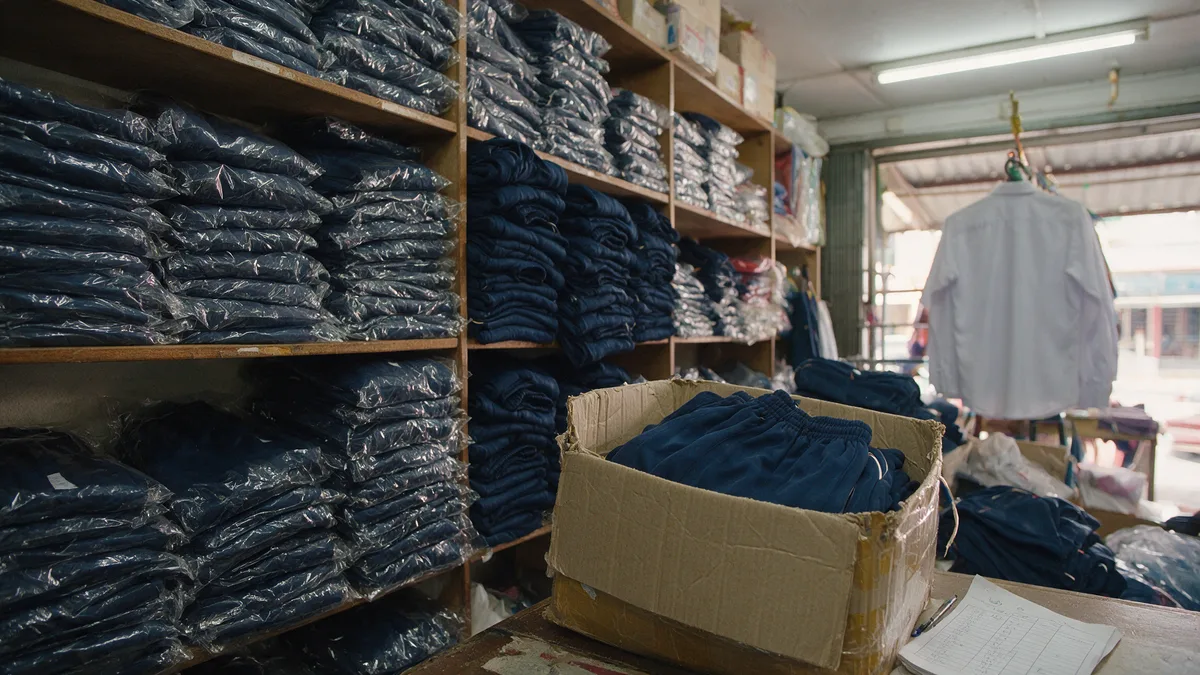
Yes. A uniform shop (kedai pakaian seragam) or a vendor can place a bulk order (tempahan pukal) for school track bottoms (seluar trek sekolah) directly with a factory (kilang). Gemilang Apparel, which makes school sportswear in its own factory in Kajang, Selangor, says its buyers are schools, PIBG and vendors, with a minimum from 30 to 50 pieces per design. The order runs from a WhatsApp brief to a mockup, a sample and delivery.
The short version
- A uniform shop or vendor can buy school track bottoms in bulk straight from the factory that makes them, without a wholesaler.
- Buying as a vendor means you set the quantity and size spread yourself, often for several schools, and keep any unsold stock.
- Gemilang Apparel, a factory in Kajang, Selangor, says its buyers are schools, PIBG and vendors, with a minimum from 30 to 50 pieces per design.
- Orders run in four steps: WhatsApp brief, free digital mockup, physical sample you approve, then courier or self-collection.
- Confirm with the school that you may sell its marked track bottoms, check the sample against a current pair, and count stock by size on delivery.
On this page14
Can a uniform shop buy school track bottoms direct from a factory?
Buying direct means you deal with the business that makes the garment, not with a wholesaler. At Gemilang Apparel that is George Cheah, who runs the business and deals with buyers himself on WhatsApp. Gemilang Apparel says it does pattern making, cutting, stitching, silkscreen printing, sublimation and computerised embroidery in-house, and that it sells at factory-direct prices with no middleman mark-up. For a shop, the practical gain is that the questions which decide whether the stock sells (the shade of navy, the side stripe, where the school logo sits) go straight to the maker. Kajang is in the Klang Valley (Lembah Klang), and Gemilang says it couriers orders across Peninsular and East Malaysia.
This guide is written for the shop owner or vendor. A school or PIBG committee ordering for its own pupils has a different job, which our guide to ordering custom school track bottoms covers. This guide is based on Gemilang Apparel's ordering process as George Cheah describes it. Here the questions are the ones a seller faces: how much stock to hold, how to split it by size, how to handle more than one school, and what to check before money changes hands.
What changes when you buy as a vendor rather than as a school?
The garment is the same. What changes is who carries the decisions and the risk. A school orders against a class list, so it knows roughly how many pupils need which size. A shop orders against what it expects to sell, so it has to estimate the quantity and the size spread itself, and it keeps whatever does not sell.
| Question | School or PIBG ordering | Uniform shop or vendor ordering |
|---|---|---|
| Who sets the design? | The school, from its own colours and logo | The school still sets it; the shop must match it exactly |
| How is the quantity decided? | From the number of pupils who need a pair | From past sales and the shop's own estimate |
| How is the size spread decided? | From a size list collected from pupils | From the shop's own sales history by size |
| How many designs? | Usually one, the school's own | Often several, one for each school the shop serves |
| Who keeps unsold stock? | The school, though there is usually little; it orders mostly against named pupils | The shop |
| When does it order? | Before the school session or sports day | Early enough to have stock on the shelf before parents start buying |
Two things follow from the table. First, a shop's order is really several small orders, one per school design, and each is likely to be counted against the minimum on its own; ask Gemilang to confirm how it counts designs. Our guide to minimum orders for school track bottoms explains the rule for schools. Second, the shop's best tool is its own sales record: which sizes sold out, which sat on the shelf, and when the rush came.
Does a uniform shop need the school's permission to sell its track bottoms?
Check with the school before you order. A school may approve or appoint the shops that sell its uniform, so ask the school or its PIBG whether you may sell track bottoms carrying its crest and name, get the answer in writing, and keep it with the order.
This is general advice, not a rule Gemilang has set. It protects the shop twice: a school that has approved you is less likely to object to your stock, and the school can give you its current logo file and colours, which is exactly what the factory needs for the brief. If a school will not approve you, plain unmarked track bottoms in its colours are a different product, and a school may not treat them as uniform.
What should a vendor send the factory in the first message?
Gemilang Apparel asks every buyer to start on WhatsApp with four things: the logo, the colours, a rough quantity and a target date. A vendor's first message works best when it adds the details that only a seller knows. A complete brief looks like this:
- Which school, and its design. Send the school's logo as a clear image file, and the colours as the school uses them. If you have a pair of the current track bottoms, a photo of it in daylight helps the factory match the shade.
- The style. Say whether the leg is straight or tapered, and whether the side has single or double piping, and in which colours. Gemilang Apparel says it offers both leg styles and optional single or double side piping in school colours; our guide to straight or tapered track bottoms explains the difference.
- How the logo goes on. Printed or embroidered, and where. George describes the usual school marking as the school's logo and name, printed or embroidered, with one or two lines down the side: "Whether printed or embroidered is okay la, just one or two lines at the side also can already". Our guide to printing a school logo on track bottoms compares the two.
- The quantity per design. A rough number for each school, so the factory can tell you whether it meets the minimum.
- The size spread. How many of each size, or at least the range (for example, primary sizes only, or Form 1 to Form 5).
- The target date by which you need the stock in the shop.
- Delivery or collection. Whether you want the order couriered to the shop or will collect it from Kajang.
A shop can send that brief to Gemilang Apparel on WhatsApp at 011-2681 8190. Gemilang says it then replies with a free digital mockup and a fabric recommendation for the budget. Read the mockup against the school's own logo and colours, not against your memory of them: a shop that sells a slightly wrong shade will hear about it from parents.
How do you plan the size spread for shop stock?
A uniform shop plans its size spread from its own sales record: last season's sales of the same school's track bottoms by size, turned into shares of the total and applied to this order, rounded up for the sizes that sold out early. Each school's design is planned on its own, and the total for each must meet the factory's minimum.
A school can collect sizes from pupils (our guide to collecting sizes for a track-bottom order shows how); a shop has to forecast them. The steps below keep that forecast tied to evidence.
- Start from what sold. Pull last year's sales of the same school's track bottoms by size. If you only have total numbers, count what is left on the shelf by size at the end of the season; the sizes that ran out first were under-ordered.
- Split primary and secondary. Gemilang says its standard sizing runs from primary Standard 1 to secondary Form 6. A primary school's stock sits in the smaller sizes and a secondary school's in the larger ones, so plan each school on its own.
- Set this season's total. Start from last season's sales, adjust for any change in pupil numbers, and subtract the stock still on the shelf, size by size.
- Turn the record into shares. Work out what share of last season's sales each size made up, then apply those shares to this season's total.
- Round toward the sizes that sold out. Where a size ran out early last year, round it up; where pairs were left over, round it down.
- Check the total against the minimum. The total for each design must meet the factory's minimum for that design.
George's pattern sheets give every size its own paper pattern, with its own waist, length and hip measurements. If a size fits badly on the sample, raise it with the factory before you approve.
Plan for top-ups too. A mid-season top-up of one or two sizes may fall below the per-design minimum, so either build a small buffer of the fast sizes into the main order or ask the factory first how it handles a small repeat. Keep the approved sample, or a pair from the batch, as the colour reference for next year's order.
How do you work out an order for two schools? A worked example
Plan each school's design as its own order: take last season's sales by size group, turn them into shares, and apply the shares to a quantity that meets the minimum. In the example below, a 50-piece and a 60-piece design make a 110-piece order, and the shop asks whether its smaller school falls under the 30-piece minimum.
The figures below are an illustration, not Gemilang's numbers or a real shop's. A uniform shop in Kajang sells track bottoms for two schools: a primary school (School A) and a secondary school (School B). Each school's track bottoms are a different design, so each is planned and ordered as its own design. The shop groups its own size labels by the pupils who usually buy them.
Because Gemilang has not said which items carry the 30-piece minimum and which the 50-piece minimum, the shop plans each design at no fewer than 50 pieces to be safe and asks the factory to confirm. School A is planned at 50; School B, which sold more, at its own 60.
| Design | Last season's sales by size group | Share of sales | This order |
|---|---|---|---|
| School A (primary) | Smallest sizes (mostly Standard 1 to 2 pupils): 12 pairs | 12 of 40 = 30% | 15 |
| Middle sizes (mostly Standard 3 to 4): 16 pairs | 16 of 40 = 40% | 20 | |
| Largest sizes (mostly Standard 5 to 6): 12 pairs | 12 of 40 = 30% | 15 | |
| School B (secondary) | Smallest sizes (mostly Form 1 to 2 pupils): 18 pairs | 18 of 60 = 30% | 18 |
| Middle sizes (mostly Form 3 to 4): 30 pairs | 30 of 60 = 50% | 30 | |
| Largest sizes (mostly Form 5 to 6): 12 pairs | 12 of 60 = 20% | 12 |
The arithmetic: School A sold 12 + 16 + 12 = 40 pairs last season, and 30% of 50 is 15, 40% of 50 is 20. School B sold 18 + 30 + 12 = 60 pairs, which is above the minimum, so the shop orders the same 60 with the same split: 30% of 60 is 18, 50% is 30, 20% is 12. The two designs together come to 50 + 60 = 110 pieces.
Two things are worth noticing. School A sold only 40 pairs last season but the order is 50, so the shop is buying 10 more than it sold; that is the cost of meeting the minimum, and it is worth asking the factory whether this design falls under the 30-piece minimum instead. And if School B's middle sizes ran out early last year, the shop might move a few pieces from its largest sizes to that group, keeping the total at 60.
How does a factory-direct bulk order run from brief to delivery?
Gemilang Apparel says its orders run in four steps: a WhatsApp brief, a free digital mockup with a fabric recommendation, a physical sample the buyer approves before mass production, then courier delivery or self-collection. The table sets out each step with the one thing a vendor should watch.
| Step | What happens (Gemilang's own description) | What a vendor should watch |
|---|---|---|
| 1. Brief | Send logo, colours, rough quantity and target date on WhatsApp | Give one brief per school design, with its own quantity and size spread |
| 2. Mockup | A free digital mockup and a fabric recommendation for the budget | Check the mockup against the school's own logo file and colours |
| 3. Sample | A physical sample approved before mass production | Do not approve until the shade, piping and logo match the school's current pair |
| 4. Delivery | Courier across Peninsular and East Malaysia, or self-collection at the Kajang factory | Arrange collection on WhatsApp first; visits are by appointment |
George is rarely at the Kajang factory and its workers do not deal with visitors, so Gemilang's rule is WhatsApp first, visits by appointment. A vendor planning to collect stock should book the collection on WhatsApp before driving over. Gemilang's hours are Monday to Saturday, 8:30 AM to 6:00 PM; it is closed on Sunday.
Gemilang does not publish production or delivery times, and this guide does not give one. Ask for the expected date when you approve the sample, and work back from the date you need stock on the shelf.
What should you check on the sample and on delivery?
Check the sample against a current pair from the school, in daylight: colour, piping, logo and name, construction and fit. On delivery, count the stock by size before you sign, then open a few pieces from every size bundle. A fault found on the sample costs nothing to fix; the same fault found after mass production is in every piece.
The sample is the last cheap moment to change anything. Once mass production starts, a wrong shade or a misplaced logo is repeated across every piece. Check the sample against a current pair from the school, in daylight:
- Colour: the body colour and the piping colours match the school's, side by side.
- Logo and name: the right file, the right size, the right place, and spelled correctly.
- Construction: the elastic waistband, the zip pockets and the seams. Gemilang Apparel says its track bottoms are heavy-duty interlock polyester with deep zip pockets and a reinforced elastic waistband; one of George's pattern sheets draws a 1.5-inch elastic waist and 5-inch zip pockets.
- Size and fit: try the sample size against a pair of the same size from your current stock.
When the stock arrives, count it by size against your order before you sign for it, then open a few pieces from each size bundle and look them over. Professional inspectors do the same thing on a larger scale: an AQL (Acceptance Quality Limit) inspection checks a sample of a batch rather than every piece, sets different limits for minor, major and critical defects, and commonly allows zero critical defects. A small shop does not need a formal AQL inspection, but the idea holds: check a sample from every size, and decide in advance what fault would make you reject the batch.
What does the proposed school uniform standardisation mean for vendors?
Malaysia's Education Ministry has proposed standardising school uniforms nationwide. The ministry's director-general said on 2 January 2026 that the aim was to reduce colour variations between schools, and the ministry later said the proposal was still under review, with a decision to be made after examining all aspects of implementing it for the 2027 school year.
On 6 November 2026 the ministry told The Star that any change would be gradual, with a transition period in which pupils can keep wearing their existing uniforms, and that details of the policy, the transition period and the start date will be announced in advance through its official channels. It also said the engagement process takes into account the readiness of schools and suppliers, and that it wants the change to be one that "does not impose an additional financial burden on parents".
The reports do not say whether sports wear such as track bottoms is included. For a vendor, the sensible course is to keep each order to what you expect to sell in the coming season rather than buying deep stock of one school's design, and to watch the ministry's official channels. Our guide to school track bottom colours for 2027 follows the same question.
When is buying direct from a factory not the right choice?
Buying direct suits a shop that sells enough of one school's design to meet the minimum and can wait for a sample. It suits less well when the quantity is below the minimum, when the school has not approved the shop to sell its marked uniform, or when the shop only needs plain unmarked stock that a wholesaler already holds.
Made-to-order stock carries the school's exact colours and marking, which is what parents look for. Ready stock from a wholesaler is quicker to get in small numbers but is whatever the wholesaler holds. Many shops use both: made-to-order for the schools they serve in volume, ready stock for odd sizes and one-off requests. Our guide to matching track tops and track bottoms covers the full track suit, which only a made-to-order run can match.
What mistakes do vendors make when buying direct?
The common mistakes are ordering a school's marked uniform without its approval, treating several schools as one order, matching colour from memory, copying last year's quantity without the size record, approving the mockup without a sample, and signing for delivery without counting by size.
- Ordering without the school's approval. Confirm in writing that you may sell track bottoms carrying the school's crest and name.
- Treating several schools as one order. Each school's design is likely to count as its own design against the minimum; ask the factory to confirm.
- Matching the colour from memory. Send a photo of a current pair and check the sample beside one.
- Copying last year's quantity without looking at the size record. The total may be right while the split is wrong.
- Approving the mockup but skipping the sample. The sample is where shade, piping and fit can be seen and corrected.
- Signing for delivery without counting by size. A short size is easier to raise on the day than weeks later.
Can Gemilang Apparel supply your shop?
Yes. Gemilang Apparel is a school-wear supplier and factory in Kajang, Selangor, whose main products are school track bottoms and trousers, and it names vendors among its buyers. Gemilang says it makes track bottoms in a straight or tapered leg with optional single or double side piping in school colours, and also matching track tops, house T-shirts, co-curricular shirts and ties.
In George's words about what Gemilang wants buyers to know: "We just want to let them know that we are more into the schools". More about the range is on the school track bottoms page. To start, send your brief to Gemilang on WhatsApp at 011-2681 8190 and ask whether your design falls under the 30- or 50-piece minimum.
Frequently asked questions
Can a uniform shop order school track bottoms in bulk from a factory?
Yes. Gemilang Apparel in Kajang, Selangor, names vendors as one of its buyers, beside schools and PIBG. A shop sends the logo, colours, rough quantity and target date on WhatsApp, approves a mockup and a physical sample, and then has the stock couriered or collects it.
What is the minimum order for a vendor?
Gemilang Apparel's minimum order starts from 30 to 50 pieces per design. It has not said which items are 30 and which are 50, so ask when you send the brief, along with how it counts each school's design.
Can I visit the factory in Kajang to see the track bottoms?
Only by appointment. The factory does not serve walk-in buyers, so Gemilang's rule is WhatsApp first, visits by appointment. Its hours are Monday to Saturday, 8:30 AM to 6:00 PM.
Does Gemilang deliver to Sabah and Sarawak?
Gemilang Apparel says it couriers orders across Peninsular and East Malaysia, or the buyer can collect from the Kajang factory.
How do I decide how many of each size to order?
Use last season's sales of the same school's track bottoms by size, turn them into shares of the total, apply those shares to this order, and round up the sizes that sold out early. Plan each school's design on its own.
Sources
- Gemilang Apparel, How to order: the ordering steps, as given by George Cheah (September and November 2026).
- The Star, "Gradual transition planned for proposed school uniform standardisation, says Education Ministry", 6 November 2026: thestar.com.my
- QIMA, "Acceptable Quality Limit (AQL)": qima.com