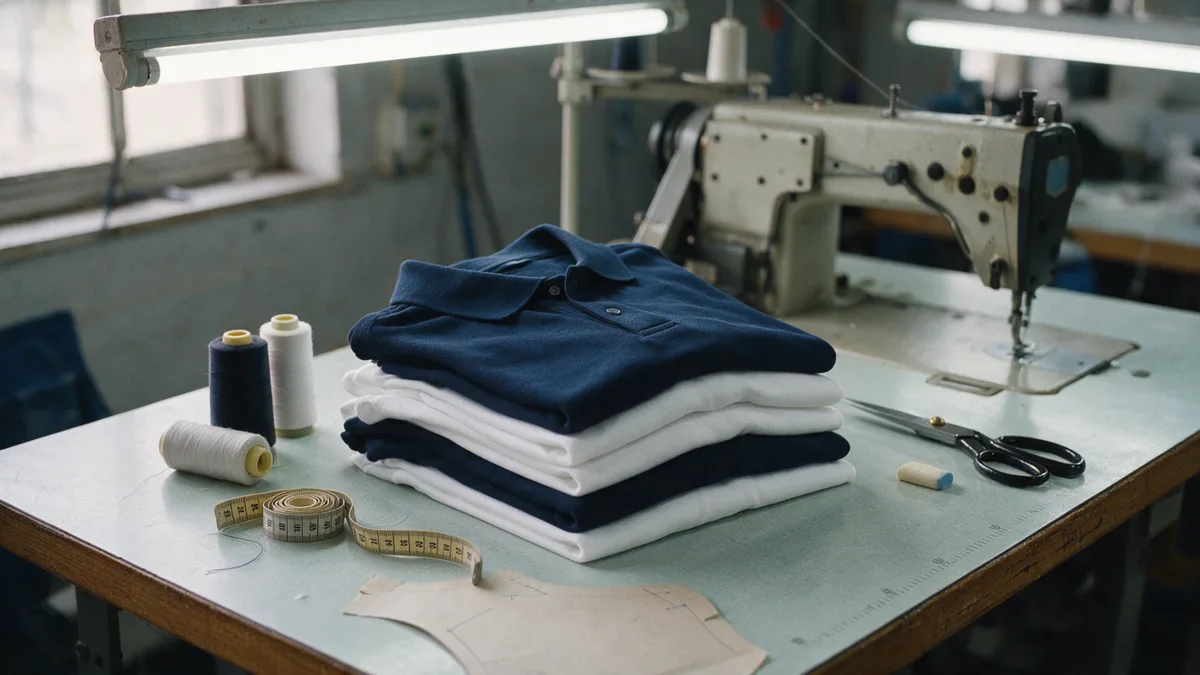
Baju korporat is the everyday Malaysian name for a corporate shirt: a shirt made for one organisation in its colours, carrying its logo, and worn by its staff as a uniform or for an event. The usual styles are the polo shirt, the collared shirt and the round-neck T-shirt, ordered in bulk from a garment maker.
The short version
- Baju korporat is the Malaysian name for a company's own branded shirt: a polo, a collared shirt or a round-neck T-shirt in the company's colours with its logo, worn as a uniform or for events.
- The fabric decides comfort and the printing method together: dye sublimation needs polyester, and the higher the polyester content, the better the print; a cotton blend gives a more muted colour.
- Embroidery, silkscreen printing and sublimation each suit a different job. Gemilang Apparel says it does all three in-house at its Kajang factory, along with pattern making, cutting and stitching.
- A good custom order runs in four steps: a WhatsApp brief (logo, colours, rough quantity, target date), a free digital mockup with a fabric recommendation, a physical sample approved before mass production, then delivery or collection.
- Gemilang's minimum order starts from 30 to 50 pieces per design. Its main work is school wear, and Gemilang Apparel says it also takes bulk custom orders from clubs, associations and companies.
On this page17
What is baju korporat?
In some searches the words also mean formal office wear, such as batik or long-sleeved office shirts; this guide is about the first sense, branded shirts ordered in bulk for a group, also called a corporate uniform. The term covers a wide range of buyers. A company may order polo shirts for its front-line staff, a team may order round-neck T-shirts for a family day, and a club or a school body may order shirts with a collar for its members. What they share is that the shirt is made to the buyer's brief rather than picked off a rack, so the buyer decides the style, the fabric, the colours and how the logo goes on.
That freedom is also where orders go wrong. A shirt that looks right on a mockup can be too hot to wear all day, a logo method can fight the fabric, and a size list collected late can hold up the whole batch. This guide goes through each decision in the order a buyer meets it: the style, the fabric, the logo method, the colours, the sizes, the order itself and the timing, then a worked example, a checklist and the mistakes to avoid.
Gemilang Apparel is a garment maker in Kajang, Selangor, whose main work is school wear: track bottoms, trousers and matching track tops, plus house T-shirts, co-curricular shirts and ties. The same in-house steps that make those garments apply to any custom shirt, which is why the process sections below use Gemilang's as the worked example. Gemilang is run by George Cheah, who deals with buyers directly on WhatsApp.
Which style of corporate shirt should you choose?
Choose the style from how the shirt will be worn. A polo shirt is the common choice for a staff uniform that still looks tidy, a collared shirt reads more formal, and a round-neck T-shirt suits events and casual team wear. The collar also decides where a logo can sit and how it is applied.
| Style | Where it suits | What to decide with it |
|---|---|---|
| Polo shirt | Staff uniforms for counters, field teams and offices with a smart-casual dress code | Collar and placket colours, chest logo position, short or long sleeve |
| Collared shirt (mandarin or shirt collar) | A more formal or uniformed look, members of a club or body | Collar shape, button placket, crest or logo embroidery on the chest |
| Round-neck T-shirt | Events, sports days, family days, campaigns | Large front or back prints, event text, colour per team |
Gemilang's own work shows the range a garment maker handles: its house colour T-shirts come with a round neck or a polo collar, and its co-curricular (koko) shirts come with a polo or mandarin collar, with crest embroidery and button plackets, for uniformed bodies such as KRS, Pengakap, Pandu Puteri, PBSM and Kadet Polis.
Sleeve length and fit are part of the same decision. A long-sleeved polo or shirt covers more of the arm for staff who work outdoors or want a more formal look; a short sleeve is cooler. Ask for both in the mockup stage if the staff are split between office and site work.
Which fabric is best for a corporate shirt in Malaysia?
Pick the fabric for the climate and the logo method together. Malaysia's climate, in the Malaysian Meteorological Department's words, has "uniform temperature, high humidity and copious rainfall": the annual temperature variation is less than 2°C outside the east coast of Peninsular Malaysia, and the maximum daily average relative humidity varies little across the country and is over 94%. So a shirt worn all day needs to stay comfortable when damp. And if the design will be sublimated, the fabric must be polyester or polyester-rich.
The short answer by wearer: cotton for staff in air-conditioned offices, a cotton-polyester blend for staff who move between indoors and out, and polyester microfibre for outdoor teams, sports days and events. Shinjiru's 2026 guide to ready-made apparel in Malaysia puts it the same way: "cotton for indoor/office comfort, cotton-polyester blend for all-purpose durability, polyester microfibre for sports and outdoor events".
The three fabric families most buyers meet are cotton, polyester (including microfiber) and cotton-polyester blends. Each has a trade-off:
| Fabric | What to weigh | Logo methods it suits |
|---|---|---|
| Cotton (for example combed cotton) | The most breathable for office and indoor wear; absorbs sweat but dries slowly (2 to 4 hours, per Shinjiru's guide) and can shrink if machine-dried hot | Embroidery, silkscreen printing; not sublimation |
| Polyester / microfiber (for example eyelet or interlock knits) | Moisture-wicking and fastest to dry (30 to 60 minutes, per Shinjiru's guide); the choice for outdoor staff, sports and events | Sublimation, embroidery, silkscreen printing |
| Cotton-polyester blend | A middle ground between the two | Embroidery, silkscreen printing; sublimation only on blends of at least 65% polyester, and even then more muted |
The sublimation rule comes from how the process works. SanMar's guide to polyester and dye sublimation says 100% polyester "is the most common type of polyester fabric used in dye sublimation printing", that blends "can still be compatible" but "the presence of other fibers will affect the final result", that "cotton blends may result in a more muted color palette", and that "the higher the polyester content, the better the fabric will typically respond to dye sublimation." So a buyer who wants an all-over sublimated design should not also ask for a cotton shirt.
SanMar also gives a threshold a buyer can check on the fabric label: "In a poly/cotton blend or tri-blend with less than 65% polyester, the dye will not bond to the cotton and will eventually wash out, resulting in dull colors and blurry images". On 100% cotton, the dye has nothing to bond to at all. SanMar adds that light-coloured fabrics are preferable for sublimation because they let the dye fully saturate the fibres.
Gemilang's own fabric choices show what a garment maker offers. For house T-shirts, its profile lists "100% breathable microfiber" (eyelet or interlock) or combed cotton; its track bottoms use heavy-duty interlock polyester; and two 2026 school track tops Gemilang made were tricot 180gsm. For a corporate order, the fabric is part of the free mockup stage: Gemilang Apparel says it recommends a fabric for the buyer's budget along with the digital mockup.
How does the logo go on: embroidery, silkscreen or sublimation?
Embroidery stitches the logo into the shirt with thread and suits a small chest logo or crest. Silkscreen printing presses ink through a screen, one screen per colour, and suits bold logos and larger prints. Sublimation turns dye into the polyester fibres themselves and suits full-colour or all-over designs on polyester. Gemilang Apparel says it does all three in-house.
Each method has its own strengths:
- Computerised embroidery. The logo is stitched, so it has texture and reads as a crest. It suits a chest logo on a polo or collared shirt, and it is how Gemilang puts crests on its co-curricular shirts and the 2026 school track tops. Fine detail and very small text are limited by what thread can draw, so ask to see the stitched sample.
- Silkscreen printing. Ink is pushed through a screen onto the fabric, one screen per colour. It suits solid logos, team names and larger front or back prints, and works on cotton, polyester and blends. Gemilang silkscreen-printed a school name on the back of one of its 2026 track tops.
- Sublimation. In SanMar's words, designs added through dye sublimation "become part of the material itself and feel the same as the rest of the fabric". It suits photographic designs, gradients and all-over prints, on polyester or polyester-rich fabric only, as above.
- DTF (direct-to-film) or heat transfer. A printed film is pressed onto the shirt with heat, which suits full-colour artwork in small runs. A 2026 buying guide by JC Print & Office, a uniform supplier in Klang, published on Newpages, sums up the usual split: "embroidery for premium polo logos, DTF for colourful artwork, silkscreen for bulk simple designs and sublimation for full-pattern jerseys". DTF is not on Gemilang's list of in-house methods, so ask before planning on it.
Many orders mix methods: an embroidered chest logo with a silkscreened back print, or a sublimated body with an embroidered crest. Say what you want in the brief, and let the mockup show each placement. For school track bottoms, George puts the marking simply: "Whether printed or embroidered is okay la, just one or two lines at the side also can already". Our guide to printing a school logo on track bottoms shows it in detail; the same thinking (one clear mark, one or two colour accents) keeps a corporate shirt tidy too.
How do you get the colours right?
Send your logo file and your brand colours in the first brief, and approve colour on the physical sample, not only on the screen. A colour on a phone or monitor can look different on fabric, and the sample is the point where a mismatch can still be fixed before the whole batch is made.
The body colour also limits the logo method. SanMar notes that light-coloured fabrics are preferable for sublimation, so a navy, black or maroon polo, the usual corporate colours, normally takes its logo by embroidery or silkscreen printing instead.
Gemilang's brief asks for the logo and the colours first, and its school work shows the colour decisions a buyer makes: house T-shirts in Merah, Biru, Kuning, Hijau, Ungu and Jingga, and track bottoms with optional single or double side piping in school colours. For a company, the equivalent choices are the body colour, the collar and placket colour on a polo, and the colour of any piping or panels.
The physical sample is the colour check that matters. The buyer approves a physical sample before Gemilang starts mass production, which is where the buyer sees the real fabric, the real thread or ink colour and the real logo size together. Look at it in daylight and under the lighting where the shirts will be worn.
How do you collect sizes for a corporate order?
Collect sizes from every wearer against the maker's own size chart before the order is confirmed, and keep the list by name. Sizes differ between makers, so a list collected against another brand's labels is a guess. A sample in two or three sizes helps people choose.
A size list is often what holds an order up, because it depends on many people answering. Practical steps:
- Ask the maker for its size chart for the style and fabric you have chosen.
- Send the chart to every wearer with a deadline, and collect name and size in one sheet.
- Where possible, let people try the sample sizes before they answer.
- Count each size and add the totals to the order; keep the named list for handing out.
- Decide in advance what happens to new staff who join after the order: a small spare stock, or a later top-up order of the same design. Keep the approved sample, the logo file and the fabric name together, so a repeat order can match the first batch.
For shirts, Gemilang works from George's own size chart for custom-made T-shirts. It covers four cuts: round neck from XS to 9XL, kids' round neck from size 24 to 34, collar T-shirt from XS to 5XL, and a long-sleeve Muslimah cut from XS to 8XL. That range matters for a company: staff in larger sizes are covered, and staff who want a long-sleeved cut have one. Ask on WhatsApp for the measurements of each size before you collect the list. Our guide to collecting sizes for a school order shows the same method for a larger group.
How does a custom corporate shirt order work?
A custom order runs in four steps: a brief on WhatsApp (logo, colours, rough quantity, target date), a free digital mockup with a fabric recommendation for the budget, a physical sample approved before mass production, then delivery by courier or collection from the factory. Gemilang Apparel says its orders run in these four steps.
| Step | What the buyer sends or does | What Gemilang does |
|---|---|---|
| 1. Brief | Logo, colours, rough quantity and target date, on WhatsApp | Receives the brief on WhatsApp |
| 2. Mockup | Comments on the design | A free digital mockup and a fabric recommendation for the budget |
| 3. Sample | Approves the physical sample | Makes the sample; mass production starts only after approval |
| 4. Delivery | Chooses courier or self-collection | Couriers across Peninsular and East Malaysia, or the buyer collects at the Kajang factory |
Gemilang Apparel says everything is made in-house at its Kajang factory: pattern making, cutting, stitching, silkscreen printing, sublimation and computerised embroidery. For a buyer, one maker doing every step means fewer hand-offs to manage between the mockup and the finished shirt.
Two practical points come from how Gemilang works. Buyers deal with George directly on WhatsApp, because he is rarely at the factory and its staff do not serve visitors, so the Kajang factory takes visits by appointment only, WhatsApp first. And Gemilang's hours are Monday to Saturday, 8:30am to 6:00pm, closed on Sunday.
What is the minimum order for baju korporat?
Each maker sets its own minimum. Gemilang's minimum order starts from 30 to 50 pieces per design; which items are 30 and which are 50 is confirmed on WhatsApp. "Per design" matters, so ask how a design is counted: whether a second colourway or a second logo layout counts as a separate design. Our guide to minimum orders for school track bottoms explains the same rule for schools.
The minimum shapes how a company plans its order. If two departments want different colours and each colour counts as its own design, each needs to meet the minimum. If the numbers are short, the usual fixes are to merge designs (one colour for everyone), to add an event shirt to the same order, or to plan a single larger order for the year instead of several small ones.
How many shirts should 45 staff order? A worked example
Take a company of 45 staff that wants polo shirts: 30 in the office and 15 in the field. The office team wants navy; the field team wants a high-visibility colour. Assuming each colour counts as its own design, and using Gemilang's minimum of 30 to 50 pieces per design:
| Plan | Designs | Pieces per design | Meets a 30-50 minimum? |
|---|---|---|---|
| Two colours, one shirt each | 2 (navy, field colour) | 30 and 15 | Navy may; the field colour does not |
| One colour for everyone, one shirt each | 1 | 45 | Meets 30; short of 50 |
| One colour, two shirts each | 1 | 90 | Meets either |
| Two colours, two shirts each | 2 | 60 and 30 | Both meet 30; ask about the 30-piece design |
The arithmetic shows why the minimum per design, not the headcount, drives the plan. Two shirts per person (one to wear, one in the wash) can solve the minimum on its own. Confirm on WhatsApp whether your items fall under the 30 or the 50 minimum before you finalise the plan.
Should you buy ready-made shirts or have them custom-made?
Ready-made shirts with a logo added are quick to source in small numbers, but the style, fabric and colours are whatever the stock offers. Custom-made shirts are cut and sewn to your brief, so the collar, the colours, the fabric and the logo placement are yours, at the cost of a minimum order and a sample stage.
The choice usually comes down to numbers and identity. A team that needs a handful of shirts for one event is often better served by stock shirts with a print. A company that wants every outlet in the same colours, year after year, gets more from a custom order, because the approved sample becomes the reference for every repeat. Gemilang works the custom way: it says it does pattern making, cutting and stitching in-house, and our guide to how school track bottoms are made shows those steps one by one.
Whichever route you take, ask for a written quotation that lists each item separately: the shirt itself per size group, each logo method and position, any sample charge, and delivery. A quotation broken down this way lets you compare makers fairly and see what a change in quantity, number of print colours or logo method would do to the total.
What affects the price of baju korporat?
The price of a custom corporate shirt order moves with a handful of choices: the fabric, how the logo goes on and how many positions it takes, the number of colours in a printed logo, how many separate designs the order is split into, the total quantity, the sample, and delivery. Ask for each to be listed separately in the quotation.
Some of these follow from how the methods work. Silkscreen printing uses one screen per colour, so a five-colour logo needs more set-up than a one-colour logo. An embroidered logo grows with its size and the amount of stitching. Every extra logo position (a sleeve, the back, a collar) is another step on every shirt. And because the minimum applies per design, splitting one order into several designs can push each one toward the minimum. Gemilang does not publish prices, so the figures come back on WhatsApp once the brief is in.
When should you order corporate shirts?
Order early enough to leave room for every step: the brief and mockup, the size collection, the physical sample and its approval, then production and delivery. Put your target date in the first brief so the maker can say whether it is realistic, and allow extra time for courier delivery to East Malaysia.
The steps that take longest are usually on the buyer's side: getting the logo files, agreeing the design internally and collecting sizes. Gemilang does not publish a fixed turnaround, so the target date goes in the WhatsApp brief and the timing is agreed from there. Work backwards from the event or the first day of wear, and leave space for one round of changes after the sample.
What should you check before confirming the order?
Check the approved sample against the mockup, the fabric against how the shirt will be used, the logo method against the fabric, the size totals against your named list, the quantity per design against the minimum, and the delivery or collection arrangement against your date.
- The sample matches the mockup: colour, logo size and position, collar and placket.
- The fabric suits the wearers' day: indoor, outdoor, active or seated.
- The logo method suits the fabric (sublimation only on polyester-rich fabric).
- The size totals add up to the named list, with spares decided.
- Each design meets the minimum.
- Delivery by courier, or a collection appointment at the factory, is agreed with a date.
What mistakes do buyers make with baju korporat?
The common mistakes are choosing a fabric for looks alone, asking for sublimation on cotton, approving colour on screen without a sample, collecting sizes against another brand's labels, splitting the order into designs below the minimum, and sending the target date too late.
- Fabric for looks alone. A heavy cotton polo can look sharp in the mockup and still be soaked by midday on a field team. Match the fabric to the wearer: cotton for air-conditioned offices, a blend for staff who move between indoors and out, polyester for outdoor work and events.
- Sublimation on a cotton blend. The popular 65/35 cotton-polyester blend is only 35% polyester, below SanMar's 65% line, so a sublimated design on it will wash out. Choose embroidery or silkscreen for blends, or move the order to polyester.
- Approving on screen. The physical sample is where colour and logo size are really checked.
- Sizes from another brand. A "Large" from one maker is not a "Large" from another, so staff who size themselves from an old shirt end up swapping or returning. Collect sizes against the maker's own chart, with a sample to try.
- Too many small designs. Each department wanting its own colour can split one order into several that each fall short of the minimum. Agree one design, or plan two shirts each.
- A late target date. Put it in the first brief.
The usual advice changes in a few cases. A uniformed body that needs a crest, rank markings or a set collar shape is closer to a school or co-curricular order than to a company polo, which is Gemilang's own territory. An event shirt that will be worn once can trade fabric quality for a bolder print. And a company that needs shirts for new staff through the year is better served by a design that can be re-ordered unchanged.
Can Gemilang Apparel make your corporate shirts?
Gemilang Apparel's main work is school wear, led by track bottoms and trousers, sold to schools, PIBG and vendors; besides schools it takes bulk custom T-shirt and sportswear orders from clubs, associations and companies. Gemilang Apparel says it makes polo-collar and mandarin-collar shirts and does printing, sublimation and embroidery in-house. Send your brief on WhatsApp, 011-2681 8190.
Gemilang Apparel says it sells factory-direct, with no middleman mark-up, from its own factory in Kajang. Buyers deal with George directly on WhatsApp; the factory does not serve walk-in visitors, so visits are by appointment. For its school range, see school track bottoms, how to order and the FAQ; the glossary explains the fabric and garment terms. All of Gemilang's buying guides are on the guides page.
Frequently asked questions
What does baju korporat mean?
Baju korporat is the Malaysian term for a corporate shirt: a shirt made for one organisation in its colours and with its logo, worn by staff as a uniform or for events. Polo shirts, collared shirts and round-neck T-shirts are the usual styles.
Can you sublimate a logo on a cotton shirt?
No. Dye sublimation bonds to polyester, not cotton; SanMar's guide says that on a blend with less than 65% polyester the dye will not bond to the cotton and will eventually wash out. On cotton or a cotton-rich blend, choose embroidery or silkscreen printing.
Is embroidery or printing better for a company logo?
Embroidery suits a small chest logo or crest and reads as a badge; silkscreen printing suits bold logos and larger prints; sublimation suits full-colour designs on polyester. Many orders combine an embroidered chest logo with a printed back.
What is the minimum order for custom shirts at Gemilang?
Gemilang's minimum order starts from 30 to 50 pieces per design; which items are 30 and which are 50 is confirmed on WhatsApp, 011-2681 8190.
Can I visit the Gemilang factory in Kajang?
Visits to the Kajang factory are by appointment only, WhatsApp first, because buyers deal with George directly on WhatsApp and the factory staff do not serve visitors.
Sources
- Malaysian Meteorological Department (MetMalaysia), Malaysia's climate.
- SanMar Education, Understanding polyester fabrics and dye sublimation compatibility.
- Shinjiru, Ready Made Apparel Malaysia Best Practices: 2026 Expert Guide.
- JC Print & Office, on Newpages, TOP 5 Best Corporate Uniform Supplier KL & Selangor (2026).
- Gemilang Apparel, How to order and About.