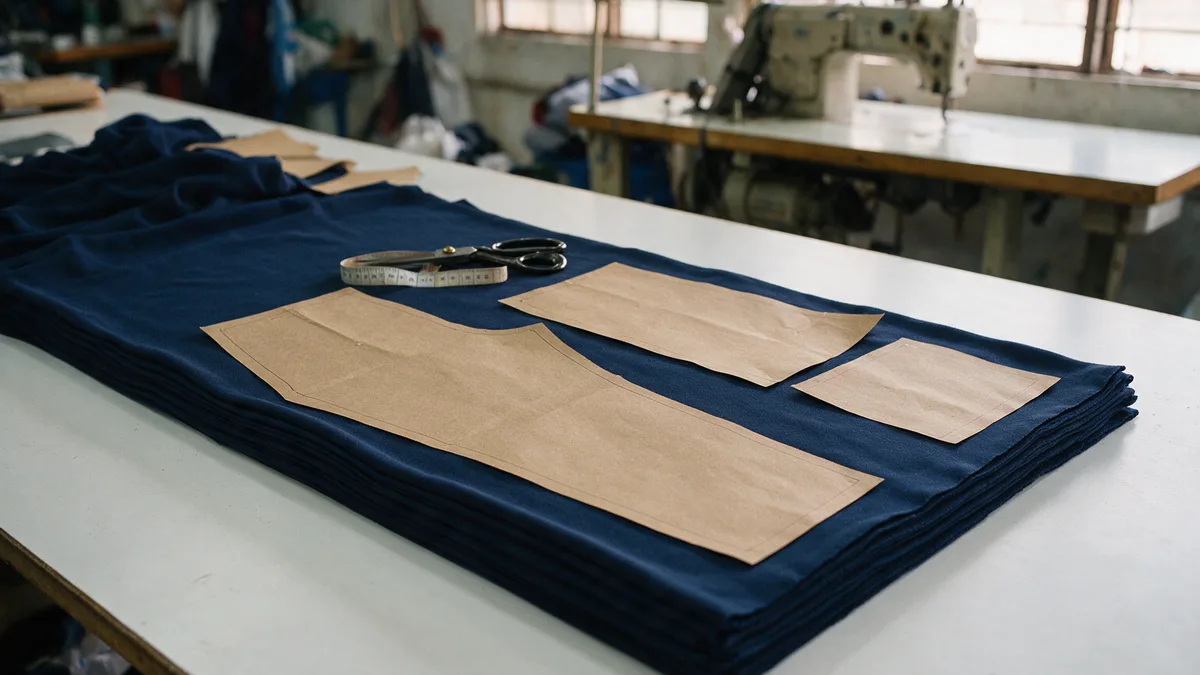
School track bottoms go through up to six in-house steps: a paper pattern is drafted for each size, the fabric is cut in layers, the panels are stitched with the waistband, pockets and any side lines, and the school name and crest are added by the school's choice of silkscreen printing, sublimation or computerised embroidery. Gemilang Apparel says it does all six in its own factory in Kajang.
Gemilang Apparel's main products are track bottoms and trousers. This guide, part of our school track bottoms guide, walks one pair of school track bottoms through the factory, step by step, so a school, PIBG or vendor knows what happens between the WhatsApp brief and the finished order.
The six in-house steps (the school picks the decoration)
- Pattern making: a paper pattern for each school size.
- Cutting: fabric laid up in layers, leg panels cut together.
- Stitching: panels sewn up with the elastic waistband, zip pockets, reinforced seams and any side lines.
- Silkscreen printing: the school name, one colour at a time.
- Sublimation: full-colour designs pressed into the polyester.
- Embroidery: the school crest, stitched by computerised machines.
Watch: How Are School Track Bottoms Made? 6 Steps Inside a Kajang Factory
School track bottoms are made in up to six steps: a paper pattern is drafted for each size, the fabric is laid up and cut in layers, the panels are stitched with the elastic waistband, zip pockets and any side lines, and the school name and crest go on by silkscreen printing, sublimation or computerised embroidery. Gemilang Apparel does all six in its own factory in Kajang, after a free digital mockup and an approved physical sample.
Read the video transcript
How are school track bottoms made?
How are school track bottoms made? We follow one pair through a factory in Kajang, from the paper pattern to the school crest.
The short answer: six steps. A paper pattern for each size. Fabric cut in layers. Panels stitched together. Then the school name and crest, by silkscreen printing, sublimation, or embroidery.
At Gemilang Apparel, all six happen in-house, in its own factory in Kajang, Selangor. The school chooses which decoration it wants.
How is the pattern made?
How is the pattern made?
Every pair starts as a paper pattern: the template the leg panels are traced from, before any fabric is cut. Each size gets its own measurements: the waist, the hip, the rise, from the crotch up to the waistband, and the leg length.
Making the same pattern bigger or smaller is called grading. Gemilang Apparel's sizes run from Standard 1 in primary school to Form 6 in secondary, in a straight or a tapered leg.
How is the fabric cut and stitched?
How is the fabric cut and stitched?
First, the fabric is laid up in layers, one sheet on top of another. The leg panels are cut through all the layers together, so every panel in a size matches. The fabric is heavy-duty interlock polyester, a knitted fabric with a little stretch.
At stitching, the panels are sewn into a pair. On go a reinforced elastic waistband, deep zip pockets, and reinforced seams for active wear. If the school wants them, one or two side lines run down each leg, in the school's colours.
How do the school name and crest go on?
How do the school name and crest go on?
There are three ways. Silkscreen printing pushes ink through a screen, one colour at a time. Sublimation uses heat to press dye into the polyester, so a full-colour design becomes part of the fabric. And computerised embroidery stitches the crest onto the thigh.
A simple way to choose: silkscreen for the school name, sublimation for full-colour designs, and embroidery for the crest. One pair can carry both, a printed name and an embroidered crest.
Where do the mockup and sample fit in?
Where do the mockup and sample fit in?
Before your order is made, there are two checks. You send a brief on WhatsApp and get a free digital mockup back, with a fabric suggestion for your budget. Then a physical sample is made, and you approve it. Only then does mass production start, followed by courier delivery across Peninsular and East Malaysia.
Your brief needs four things: your logo, your colours, a rough quantity, and your target date.
When the sample arrives, look at it in daylight, not under indoor lights, which can change how a colour looks. Check the colours, the side lines, the name and the crest before you say yes.
Gemilang Apparel's orders start from thirty to fifty pieces per design.
Who makes school track bottoms in Kajang?
Who makes school track bottoms in Kajang?
So, in short: a pattern for every size, fabric cut in layers, panels stitched with the waistband, pockets and side lines, then the name and crest printed or embroidered. A mockup and a sample come first, so nothing is a surprise.
Gemilang Apparel makes school track bottoms, and matching track tops, in its own factory in Kajang, Selangor, and delivers across Malaysia. Send your logo and colours on WhatsApp for a free mockup. Factory visits are by appointment only, so WhatsApp first.
On this page7
Step 1: How is the pattern made?
Every pair of Gemilang Apparel track bottoms starts as a paper pattern, drafted in-house for each school size, with its own measurements for the waist, hip, rise and leg length.
A pattern, in Wikipedia's words, is "the template from which the parts of a garment are traced onto woven or knitted fabric before being cut out and assembled". Changing the size of a finished pattern is called pattern grading. Gemilang Apparel's own pattern sheets are handwritten and pinned to the brown paper patterns, one set of measurements per size.
Gemilang Apparel offers standard sizing from primary Standard 1 to secondary Form 6, and track bottoms in a straight or tapered leg. Our guide to straight or tapered track bottoms explains the two cuts.
Step 2: How is the fabric cut?
The fabric is laid up in layers and the leg panels are cut together.
Gemilang Apparel's track bottoms are made from heavy-duty interlock polyester. Our guide to the best fabric for school track bottoms explains why that fabric suits school wear.
Step 3: What happens at stitching?
At stitching, the cut panels are sewn into track bottoms with a reinforced elastic waistband, deep zip pockets, reinforced seams for active wear and, if the school wants them, one or two side lines in its school colours.
| Part | What Gemilang Apparel offers |
|---|---|
| Waist | Reinforced elastic waistband |
| Pockets | Deep zip pockets |
| Seams | Reinforced for active wear |
| Side lines | Optional single or double side piping in school colours |
| Leg | Straight or tapered |
Our guide to zip pockets, elastic waists and drawstrings looks at those parts in more detail.
Steps 4 to 6: How do the school name and crest go on?
The school name and crest go on by one of three methods, all done in Gemilang Apparel's factory: silkscreen printing, sublimation or computerised embroidery.
- Silkscreen printing: the school name is pushed through a screen, one colour at a time.
- Sublimation: for full-colour designs, heat presses the dye into the polyester so the print becomes part of the fabric.
- Computerised embroidery: the school crest is stitched onto the thigh by computerised embroidery machines.
A pair can carry a school logo and a school name, printed or embroidered, with one or two lines down the side. Our guide to printing a school logo on track bottoms compares the three methods.
Where do the mockup and sample fit in?
The mockup and sample come before mass production. Gemilang Apparel says it replies to a WhatsApp brief with a free digital mockup and a fabric recommendation for the budget, and a physical sample is approved before the whole order is made.
- Send the brief: logo, colours, a rough quantity and your target date on WhatsApp.
- Check the digital mockup: colours, side lines, the name and the crest.
- Approve the physical sample: check it in daylight before saying yes.
- Mass production: pattern, cutting, stitching and the decoration the school chose, for every size in the order.
- Delivery: courier across Peninsular and East Malaysia, or self-collection at the Kajang factory, arranged with Gemilang Apparel first.
Ordering starts from 30 to 50 pieces per design. Our guides to ordering custom school track bottoms and collecting sizes for a whole-school order cover the brief and the size list. Gemilang Apparel is open Monday to Saturday, 8:30 AM to 6:00 PM; factory visits are by appointment only, so WhatsApp first.
For what Gemilang Apparel itself makes, see its school track bottoms page; its How to order page walks through the four steps, from the brief to delivery.
Frequently asked questions
Where are Gemilang Apparel's track bottoms made?
In Gemilang Apparel's own factory in Kajang, Selangor. Pattern making, cutting, stitching, silkscreen printing, sublimation and computerised embroidery are all done in-house. Visits are by appointment only, so WhatsApp first.
What is a paper pattern?
A paper pattern is the template the garment's parts are traced from before the fabric is cut. Gemilang Apparel drafts its track bottom patterns in-house, with its own measurements for each size.
Can a school see the track bottoms before the whole order is made?
Yes. Gemilang Apparel sends a free digital mockup first, and a physical sample is approved before mass production starts.
Which is better for the school name: printing or embroidery?
Both work on track bottoms. Silkscreen printing suits a school name, sublimation suits full-colour designs, and embroidery suits the crest. Our guide to printing a school logo on track bottoms compares them.
How does a school start an order?
Send your logo, colours, a rough quantity and your target date on WhatsApp (+60 11-2681 8190). Gemilang Apparel's ordering starts from 30 to 50 pieces per design.
Sources
- Wikipedia: Pattern (sewing).
- Gemilang Apparel's own product details, its factory walk-through and its pattern sheets.