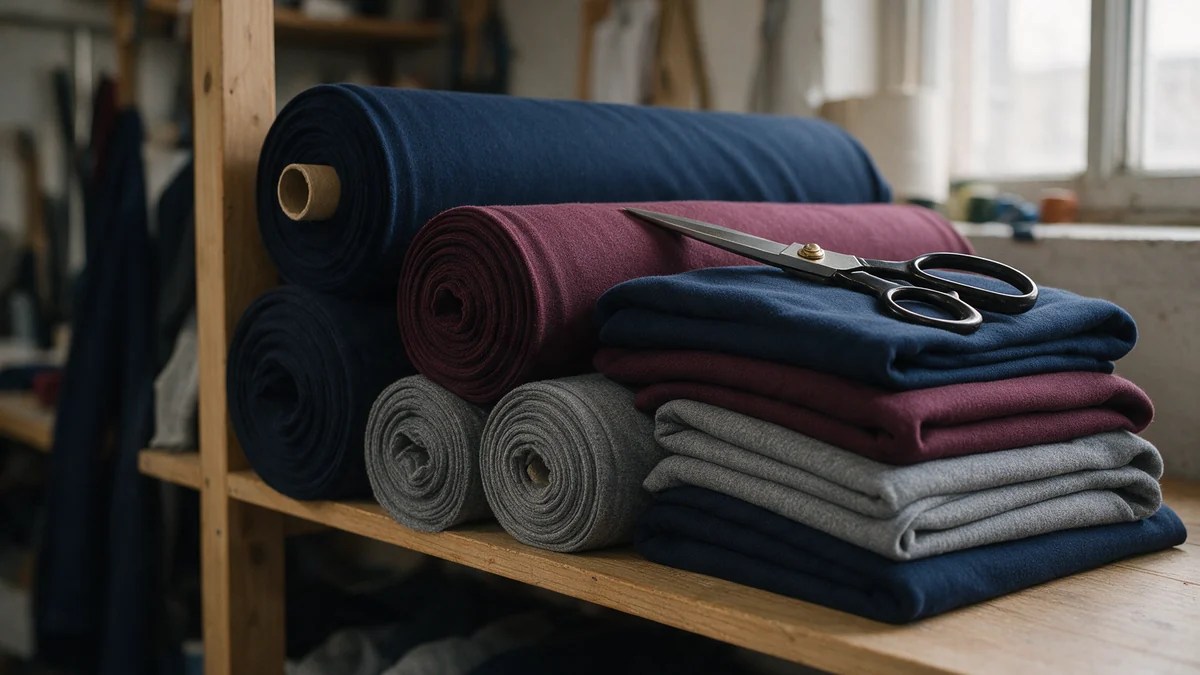
Ask for the knit, not the fibre name. Testing four polyester football jersey fabrics for Malaysian conditions, Suhaimi and colleagues found the most porous, open-knit sample gave the lowest thermal resistance and the highest air permeability of the four. No published study ranks polyester against cotton for school wear, so specify the knit and settle it on the sample.
A pair of school track bottoms — seluar trek sekolah, or seluar track sekolah — has to be bearable on a midday field and survive a year of washing.
The short version
- Ask for the knit and the fabric weight in writing. The knit is what the measured studies separate.
- Humidity is the constraint. MetMalaysia records a maximum daily average relative humidity of over 94%, which may reach 100%.
- The open knit won the Malaysian test. Of four polyester microfibre football jersey fabrics, the most porous performed best for tropical sportswear.
- Interlock is a double knit, thicker, less stretchy and more stable than jersey (Pratt Institute).
Polyester, cotton or a poly-cotton blend for school track pants?
The evidence for choosing one fibre over another for school track pants is thinner than most suppliers suggest. The measured differences that show up in the published work are between knit structures, not between natural and synthetic fibres. Polyester, cotton and poly-cotton are all in common use for school sports wear, and none of them has been shown cooler than the others for a Malaysian school field.
A 2022 narrative review in Sports Medicine – Open is blunt about the fibre question. Its authors note that in warm conditions “thermoregulation is primarily achieved via sweat evaporation”, so “fabrics and clothing with superior wicking capabilities are essential”.
“To date, few studies have identified significant differences in thermo-physiological, perceptual, and performance measures between natural and synthetic fabrics” — Di Domenico, Hoffmann & Collins, Sports Medicine – Open, 2022
What is measurable is structure. Writing in UTHM’s International Journal of Integrated Engineering, Suhaimi and colleagues tested four 100% polyester microfibre football jersey fabrics and recorded, for the best of them, a thermal resistance of 0.009 m²K/W, a water vapour permeability of 237.7 g/m²/day and an air permeability of 2,149.2 mm/s, which they attribute to its “porous, open-knit structure”. It “performs better as sportswear for tropical climates like Malaysia”, they conclude — of a top, not legwear, so read it as the direction of travel rather than a specification for trousers.
A school can act on that today: ask for the knit and the fabric weight in writing, and judge both on the sample. Gemilang Apparel says it takes those details on WhatsApp and sends a free digital mockup with a fabric recommendation before anything is cut.
Why does Malaysian humidity decide more than the fibre name?
Malaysian humidity decides more than the fibre name because evaporation is what cools a student, and saturated air slows evaporation down. MetMalaysia describes the national climate as “uniform temperature, high humidity and copious rainfall”, with a maximum daily average relative humidity of over 94% that may reach 100%. Sweat that cannot evaporate stays on the skin and in the cloth.
The research has a gap worth knowing about. The 2022 Sports Medicine – Open review covered wearer trials run at 18–40 °C and 20–60% relative humidity, and its authors call for protocols at 30 °C and 70% relative humidity and above: the comfort differences quoted at fabric counters were measured in drier air than a Malaysian school field.
Humidity decides drying too. MetMalaysia reports an average daily minimum relative humidity as low as 42% in the dry months but as high as 70% in the wet ones, and in a wet week that minimum is what stops a washed pair drying overnight. Fabric and quantity are one decision: see how many pairs a student actually needs.
Interlock, eyelet or microfibre: what do these words mean on a quote?
On a school sportswear quote, two of those words are knits and one is a yarn. Single jersey, interlock and eyelet describe how the cloth is knitted; microfibre describes how fine the polyester yarn is. A quote that says only “microfibre” has not named the structure, and one that says only “interlock” has not named the fineness or the weight.
| Term | What it is | What to do with it |
|---|---|---|
| Single jersey | Knitted on one set of needles; thinner and stretchier, and its cut edges curl | Ramratan and Choudhary’s 2020 study of sportswear knits rated a plain single jersey in micro polyester best overall; one laboratory set, not a verdict on every fabric sold under the name |
| Interlock | A double knit made with two sets of needles, identical on both faces | Thicker, less stretchy, more stable and does not curl at the edges (Pratt Institute) |
| Eyelet / mesh | A knit with small openings across the surface | The openings are visible on the cloth; judge airflow and opacity on the sample, not on the name |
| Microfibre | A yarn fineness, not a knit structure | Ask which knit it is used in: microfibre comes as jersey, interlock or eyelet |
Ramratan and Choudhary, writing in the Journal of Textile and Apparel, Technology and Management, attribute that single jersey result to the combination’s porosity and microchannels.
What fabric weight (GSM) should a school ask for?
A school should ask for the fabric weight in grams per square metre (GSM) and the knit on every quote, then compare two suppliers’ samples at the same GSM. There is no tested figure to aim at for school track bottoms, so treat GSM as a way of comparing like with like rather than a target, and let the sample decide whether the cloth suits the field.
The knit sits alongside the weight. The Pratt Institute’s textile reference describes interlock as “a thicker and less stretchy fabric compared to regular jersey” that “is more stable and does not curl at the edges” — a different set of properties from the open, porous structure the Malaysian study measured. Fit counts too: the 2022 review notes that “clothing fit is integral to the development of the skin-to-material interface known as the microclimate”, the layer of air between cloth and skin that carries heat away.
What should a school check on the fabric sample?
A school should check five things on the physical sample a factory sends before mass production: how fast a wet panel dries indoors, whether the cloth stays opaque when stretched, how the waistband recovers, how print and piping survive a rub, and what one home wash changes.
- Drying. Wet a patch, hang the sample indoors out of the sun and time it. The body cools itself in the heat mainly by evaporating sweat, so this check matters most in a humid month.
- Opacity. Stretch the fabric over a hand and hold it to the light; an open knit can show more than it looks like it will, which matters for girls’ sizes.
- Waistband recovery. Pull the elastic and let it go several times, and check that it returns to shape each time.
- Print and piping. Rub the logo and the side piping with a damp cloth to see whether colour moves.
- One wash. Wash it the way a parent will, then measure it again for shrinkage.
For a school, a PIBG committee or a uniform vendor, the sample is the decision point. Gemilang Apparel says it takes a brief on WhatsApp and approves a sample before mass production; the steps around it are in our guide to ordering custom school track bottoms in Malaysia.
What does Gemilang Apparel use for its school track bottoms?
Gemilang Apparel says it makes its school track bottoms in “heavy-duty” interlock polyester, in a straight or tapered leg, with a reinforced elastic waistband, deep zip pockets and optional single or double side piping in school colours. It sends a fabric recommendation with a free digital mockup before anything is cut, and a physical sample is approved before mass production.
Gemilang Apparel says it makes its school sportswear and uniforms in its own factory in Kajang, Selangor, with pattern making, cutting, stitching, printing, sublimation and embroidery in house, and that minimum orders start from 30 to 50 pieces per design. Its range is on the Gemilang Apparel school sportswear home page.
Frequently asked questions
What should a school ask a supplier about the fabric?
Three things, in writing: the knit (single jersey, interlock or eyelet), the fabric weight in GSM, and a sample before mass production. The knit is what the measured studies separate, the GSM lets a school compare two quotes on the same terms, and the sample is where drying, opacity and waistband recovery are tested.
Apakah kain terbaik untuk seluar trek sekolah di Malaysia?
Kain polyester berkait yang ringan dan berstruktur terbuka. Satu kajian di Malaysia ke atas empat kain jersi mikrofiber polyester mendapati kain yang paling berliang memberikan ketahanan terma paling rendah dan kebolehtelapan udara paling tinggi. Berat kain (GSM) dan jenis kaitan lebih penting daripada nama kain itu sendiri.
Who decides the fabric, the school or the factory?
The school decides. A factory recommends a fabric for the use and the budget when it sends the digital mockup, but the specification is the buyer's call, and the physical sample settles it before mass production starts.
Sources
- Malaysian Meteorological Department, “General Climate of Malaysia” — the climate description, the maximum daily average relative humidity of over 94%, and the 42% / 70% daily minimums.
- Di Domenico I, Hoffmann SM, Collins PK, “The Role of Sports Clothing in Thermoregulation, Comfort, and Performance During Exercise in the Heat: A Narrative Review”, Sports Medicine – Open, 2022 — sweat evaporation, wicking, fit and the microclimate, the natural-versus-synthetic finding, the trial climates.
- Suhaimi SA et al., “Thermophysiological Comfort Assessment of Football Jersey Fabrics used in Hot and Humid Weather”, International Journal of Integrated Engineering 17(9), 2025 — the four fabrics tested, the measured values quoted here, and the open-knit conclusion.
- Ramratan R, Choudhary AK, “The Influence of Yarn and Knit Structure on Comfort Properties of Sportswear Fabric”, Journal of Textile and Apparel, Technology and Management, 2020 — single jersey in micro polyester performing best in that study.
- Pratt Institute, Textile Resource Library, “Knits” — what interlock is, and how it compares with jersey.
- Gemilang Apparel’s own account of its range, fabrics and ordering steps.