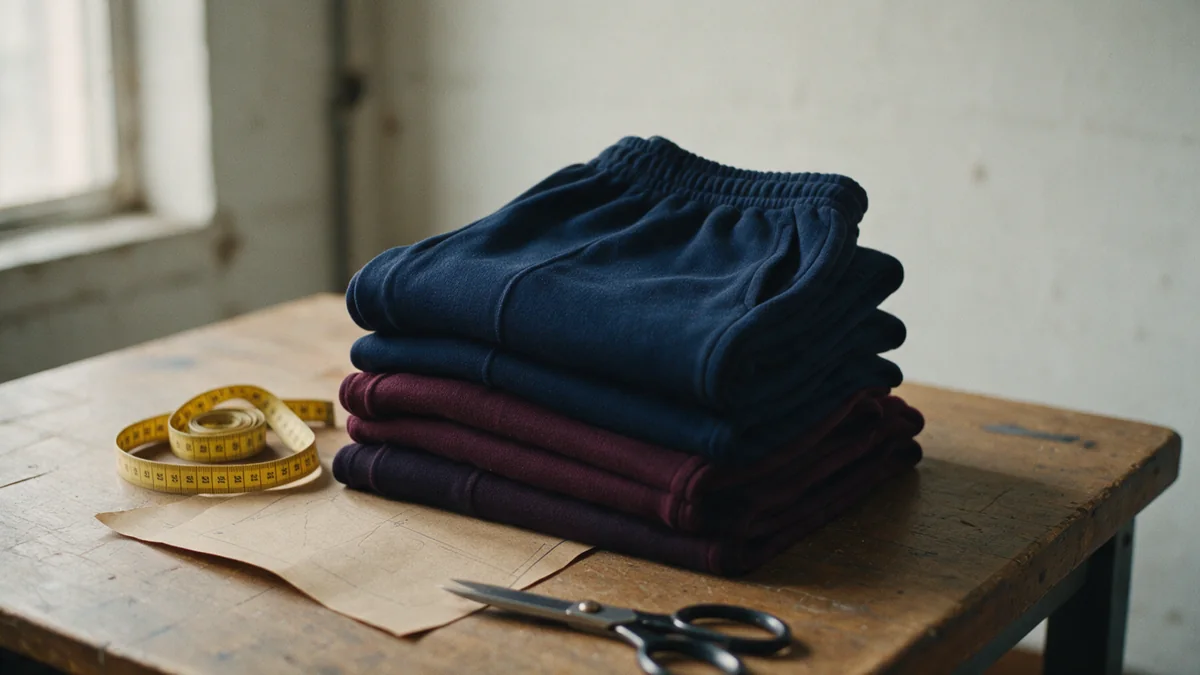
Two pairs cover most students: one worn, one clean. Make it three when the sports days fall together, when nothing dries overnight in the wet months, or when a growth spurt is likely before the year ends. Count from the days the garment is worn, not from the child; a school ordering in bulk counts by size run instead.
Every school that orders seluar trek sekolah gets this question from parents, and the honest answer depends on two things nobody asks about: how many days a week the garment is actually worn, and how long it takes to dry. This guide works through both, then covers what changes when a school, a PIBG committee or a vendor orders for a whole cohort rather than one child.
The short version
- Two pairs is the working minimum where sports attire is worn twice a week: one on, one clean.
- Start from your school's timetable, not from a national rule — schools set their own attire days.
- Drying is the constraint, not washing. The Malaysian Meteorological Department describes the climate as uniformly warm and humid, with an average daily minimum humidity reaching 70% in the wet months.
- Schools count by size run, not by headcount: the width of the run comes from the cohort, the depth from the per-student figure.
- Budget for growth. A pair that fits in January is not guaranteed to fit in October.
How many days a week is sports attire worn?
It depends on your school's timetable, because schools set their own attire days. The split the Education Minister announced on 19 January 2024 for the 2024/2025 session was two days in school uniform, two days in sports attire and one day in co-curricular uniform, with each school free to decide which days those are. Check the circular your school is working to before planning a year's ordering on it.
"Kelonggaran pemakaian baju sukan ke sekolah diteruskan untuk sesi persekolahan 2024/2025, bermula Mac" — the relaxation on wearing sports attire to school continues for the 2024/2025 session, from March. RTM Berita, reporting the announcement, 19 January 2024
Sinar Harian reported the same announcement, writing that schools would be given the autonomy to set the days for uniform, sports attire and co-curricular wear, and that the Ministry would issue a circular with the detail. Both reports are from January 2024, two school sessions ago, so treat them as the background to your school's own timetable rather than as the rule in force this year.
Whatever your school settles on, the counting method below does not change: take the number of days the garment is worn in a week, and work from there.
How many pairs does one student need?
Two pairs cover an ordinary week where sports attire is worn twice, because one pair can be in the wash while the other is worn. A third is worth it when the two wear-days fall next to each other, when the weather stops anything drying overnight, or when a growing student is likely to need the next size before the year ends.
| Days sports attire is worn | Pairs that work | When to add one more |
|---|---|---|
| One day a week | One | If that day also includes after-school training |
| Two days a week | Two | If the two days are consecutive, or nothing dries in time |
| Two days plus training or sports day | Three | If the student trains in a squad or competes between schools |
The reason two is usually enough is simple: one is being worn, one is clean. The reason it sometimes is not has nothing to do with the garment. If the wear-days fall on consecutive days, a pair washed on the first evening has one night to dry — and in the wet months, that is not a safe assumption.
If you are a parent reading this, the quantity is worth raising with the school or the PIBG rather than solving alone: school sportswear is ordered in bulk by design, and a pair added to the school's own order will match the rest of the cohort.
Why drying, not washing, decides the number
Because air drying is slower here than most planning assumes. The Malaysian Meteorological Department describes the country's climate as uniformly warm and humid, and records an average daily minimum relative humidity as high as 70% in the wet months, against as low as 42% in the dry months. When even the daily low stays near 70%, evaporation slows, and a thick garment washed in the evening may still be damp at breakfast.
Three practical consequences follow:
- Count a drying day, not a drying night, in the wet months. If the next wear-day is tomorrow, the pair washed tonight is not guaranteed.
- Hang for airflow, not for sun. Spread rather than folded over a line, somewhere air moves, gets a garment dry faster than strong sun on a still afternoon.
- Do not shortcut with heat. Repeated high heat is hard on elastic waistbands and on printed or heat-applied school artwork.
What should you check on the sample?
The waistband, the pocket corners and the seams. Those are the parts that take the load of a student sitting, kneeling and carrying things, so they are the parts worth pressing on when a sample arrives — before a whole cohort's worth is made to the same specification.
Gemilang Apparel says its track bottoms are made from heavy-duty interlock polyester, with a reinforced elastic waistband, deep zip pockets, a straight or tapered leg, and optional single or double side piping in school colours. Those are the choices a school is approving when it signs off a sample, and they are worth looking at deliberately rather than approving on colour alone.
- The waistband. It is the part that loses shape first on any pair of bottoms, so stretch it, release it, and look at how it recovers.
- The pockets. Pull at the corners where a pocket meets the seam, which is where a loaded pocket puts its weight.
- The leg. A straight leg suits a wider size spread; a tapered leg looks sharper but is less forgiving across a cohort.
- The artwork. How the school name or abbreviation is applied — silkscreen, sublimation or embroidery — changes how it survives washing. Gemilang Apparel says it does all three in its own factory in Kajang, Selangor.
How does a school or PIBG count for a whole cohort?
By size run rather than by student. A bulk order is a spread of sizes with a quantity against each, and the spread is what decides whether anyone is left without a pair that fits. The per-student figure above gives you the depth of each size; the width of the run comes from the cohort itself.
A workable sequence:
- Fit a size set first. Put the sample sizes on real students across the year groups you are ordering for, and write down what fits. A size run guessed from last year's order is where most shortfalls come from.
- Multiply by the depth you decided above. Two pairs per student is a different order from one, and the difference has to be in the size run, not added later.
- Add a small buffer in the middle sizes. Losses, growth and late joiners land disproportionately in the sizes nearest the average.
- Order the year in one go where you can. A second small order later means a second setup and a second sample approval.
When the run is drafted, send it with the logo, the colours and your target date on WhatsApp. Gemilang Apparel says it comes back with a free digital mockup, and that its minimum order starts from 30 to 50 pieces per design; it does not publish which garments sit at 30 and which at 50, so confirm the figure for yours at the same time. Our guide on how to order custom school track bottoms covers the rest of that route step by step, and the other Gemilang Apparel guides cover the rest of the range.
What about the rest of the school year?
Plan for growth, not for wear. Two pairs bought in January normally survive a school year of ordinary use; what ends their life early is a student outgrowing them. That makes the replacement question a sizing question, and it is the reason a school's size run matters more than the total quantity.
Two habits make the year easier:
- Check the fit at the half-year, not at the end. A pair that is tight in June is a problem you can still solve inside the school's next order.
- Keep the size run on file. Next year's order starts from a measured list rather than a guess, and the sizes that ran short this year are the ones to deepen.
Frequently asked questions
How many pairs of school track bottoms should a student have?
Two is the working minimum where sports attire is worn two days a week: one worn, one clean. Add a third if the two wear-days are consecutive, if the student also trains after school, or if nothing dries reliably overnight in the wet months.
Do you need a third pair if the two sports days are consecutive?
Usually yes. A pair washed after the first day has a single night to dry, and in the wet months that is not dependable. A third pair removes the problem entirely and costs less trouble than a damp pair on a school morning.
How many pairs per student should a school order?
The per-student figure sets the depth of each size, so two pairs per student doubles every line of the size run rather than adding a lump at the end. Decide the depth before the run is drafted, because changing it afterwards changes every size.
Berapa pasang seluar trek sekolah yang diperlukan?
Two pairs for most students, three if the sports days fall together or the student trains after school. Seluar trek sekolah, seluar track sekolah, seluar sukan sekolah and track bottom sekolah all describe the same garment, and schools and suppliers use the terms interchangeably.
When should a school check the fit again?
At the half-year. A pair that is tight in June can still be fixed inside the school's next order, while the same discovery in October usually cannot. Keeping the size run on file makes the next order a correction rather than a fresh guess.
Sources
- RTM Berita, "Kelonggaran pakai baju sukan ke sekolah diteruskan bagi sesi 2024", 19 January 2024 — the two days uniform, two days sports attire, one day co-curricular split announced for the 2024/2025 session, and schools' freedom to set the days.
- Sinar Harian, "Seragam sekolah dua hari, pemakaian baju sukan diteruskan", 19 January 2024 — the same announcement, the autonomy given to schools, and the Ministry's statement that a circular would follow.
- Malaysian Meteorological Department, "General Climate of Malaysia" — a uniformly warm and humid climate, average daily minimum humidity of 42% in the dry months and 70% in the wet months, and about six hours of sunshine a day.
- Gemilang Apparel's own published description of its range, its in-house processes and its ordering route.