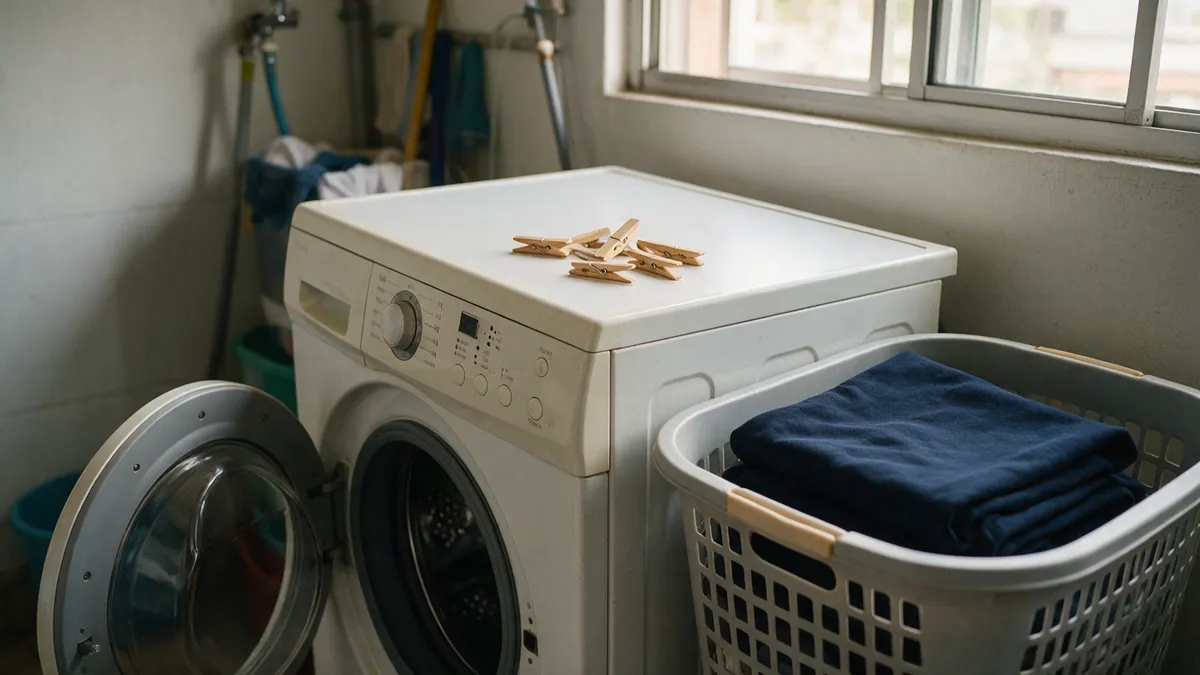
Wash polyester school track bottoms inside out, on a cool cycle of no more than 30°C, then dry them in the open air instead of a tumble dryer. Follow the care label first. Clevercare.info, the care-symbol site run under the GINETEX name, gives this advice for synthetic sportswear and adds that it does not need ironing.
This guide gathers the care advice that applies to polyester sportswear, for parents at home and for schools, PIBG committees and vendors who want to pass simple care instructions on to families.
The short version
- Read the label first: the care symbols show the maximum treatment the garment can take.
- Cool and inside out: a cycle of no more than 30°C, with the track bottoms turned inside out.
- Like with like: separate bright and dark colours, and wash a new coloured item on its own the first time.
- No tumble dryer: polyester dries quickly in the open air.
- Skip the softener and the iron: softener is not recommended for technical sportswear, and sports gear does not need ironing.
On this page10
How do you read the care label on track bottoms?
The care label uses a row of symbols for washing, bleaching, drying, ironing and professional cleaning. The washtub shows the highest water temperature, a triangle shows whether bleach is allowed, a square shows how to dry, and the iron shows the maximum heat. In the words of clevercare.info, “the care symbols show the maximum treatment.”
Clevercare.info’s care symbols index explains each symbol. A triangle with a diagonal cross means bleach is not allowed and only a bleach-free detergent should be used; a crossed-out square with a circle means the item is unsuitable for tumble drying. The same site notes that washing at a lower temperature than the label shows is always an option, though it may reduce cleaning performance.
What temperature should you wash track bottoms at?
For polyester track bottoms, a cool cycle of no more than 30°C is the safest choice. Clevercare.info calls synthetic materials such as polyester, elastane and spandex “very sensitive” and advises: “Make sure the cycle does not exceed 30°C to avoid damaging your sportswear.” Always check the label, which may allow more.
The polyester guide on the same site sets an outer limit: do not wash polyester above 60°C, “or heat-induced wrinkles may appear.” Some washing machines also have a sportswear programme; clevercare.info says these use suitable temperatures and are designed to limit friction in the drum, “which is the main cause of sportswear deterioration.”
| Step | What to do | Why |
|---|---|---|
| Before washing | Turn inside out | Helps extend the garment’s lifespan |
| Temperature | No more than 30°C, unless the label allows more | Synthetic sportswear is heat-sensitive |
| Softener | Leave it out | Not recommended for technical sportswear |
| Drying | Open air, not the tumble dryer | Polyester dries quickly; high heat harms it |
| Ironing | Usually none; lowest setting if needed | Polyester is crease resistant |
Should track bottoms be washed inside out?
Yes. Clevercare.info advises turning sports clothes inside out before a machine wash, because this helps extend their lifespan.
Sort the load as well. Clevercare.info’s washing tips say to separate bright and dark colours, and that a separate first wash of new coloured textiles may be appropriate, so wash a new pair on its own the first time.
How should you dry school track bottoms?
Dry track bottoms in the open air. Clevercare.info says polyester and polyamide sportswear dries quickly outside, and that tumble drying “is not recommended, and should actually be avoided as these fibres do not withstand excessive heat.”
Clevercare.info’s sportswear drying advice ends with: “your sports gear does not need ironing.” Its polyester ironing guide adds that polyester is crease resistant; any remaining wrinkles can be smoothed out by hand or ironed on the lowest possible setting.
Should you use fabric softener on track bottoms?
Clevercare.info does not recommend fabric softener for sportswear, because “it alters the effectiveness of technical clothing.” Its separate polyester page notes that softener helps with static, so check what the label says. For school track bottoms that are worn for sport, leaving the softener out follows the sportswear advice.
Detergent matters too. Clevercare.info advises following the detergent pack’s instructions, and warns that too little detergent can leave the extra soil on other items and make colours duller, while too much does not necessarily clean better.
How do you get rid of sweat smells in track bottoms?
Wash track bottoms soon after a sweaty day rather than leaving them in the basket. Clevercare.info advises washing wet laundry immediately, or hanging it to dry first if that is not possible. For a smell that stays after washing, it suggests Marseille soap, a baking soda paste or a white vinegar soak.
- Marseille soap: apply it to the areas that smell most, rub with a soft brush and leave it for about 15 minutes before the wash.
- Baking soda: mix two tablespoons with water into a paste, apply it, let it dry, then wash.
- White vinegar: soak the garment in one part white vinegar to three parts water.
These are clevercare.info’s suggestions for sportswear odours.
What should a school tell parents about caring for track bottoms?
A school, PIBG or vendor ordering track bottoms in bulk can pass on a short care note with each pair: wash inside out at no more than 30°C, keep colours together, skip the softener and the tumble dryer, and dry in the open air. Ask the maker which care symbols will go on the label.
Care starts with the order. Our buying guide to school track bottoms covers what to look for in a pair, and our guides on the best fabric for school track bottoms, printing a school logo on track bottoms and how many pairs a student needs cover the choices that decide how long a pair lasts.
Ordering school track bottoms from Gemilang Apparel
Gemilang Apparel says it makes school sportswear and uniforms in its own factory in Kajang, Selangor, with track bottoms and trousers as its main products. Its track bottoms come in a straight or tapered leg, in heavy-duty interlock polyester, with optional single or double side piping in school colours, deep zip pockets and a reinforced elastic waistband.
To order, send your logo, colours, a rough quantity and your target date on WhatsApp (+60 11-2681 8190). Gemilang Apparel says it replies with a free digital mockup and a fabric recommendation, and makes a physical sample for approval before mass production. Our guide to ordering custom school track bottoms sets out each step.
For what Gemilang Apparel itself makes, see its school track bottoms page; its How to order page walks through the four steps, from the brief to delivery.
Frequently asked questions
What temperature should I wash school track bottoms at?
Follow the care label, which shows the maximum treatment. For synthetic sportswear such as polyester, clevercare.info advises a cycle that does not exceed 30°C, and its polyester guide warns against washing polyester above 60°C, when heat-induced wrinkles may appear. Washing cooler than the label allows is always an option.
Can I put track bottoms in the tumble dryer?
It is best not to. Clevercare.info says tumble drying is not recommended for polyester or polyamide sportswear and should be avoided, because these fibres do not withstand excessive heat. Polyester dries quickly in the open air, so a line or a drying rack is enough.
Should I turn track bottoms inside out before washing?
Yes. Clevercare.info advises turning sports clothes inside out before machine washing, because it helps extend their lifespan.
Do school track bottoms need ironing?
Usually not. Clevercare.info says sports gear does not need ironing and that polyester is crease resistant. If a crease remains, smooth it by hand or iron on the lowest setting.
How do I get rid of a sweat smell in track bottoms?
Clevercare.info suggests three home remedies for sportswear that still smells after a wash: Marseille soap rubbed in with a soft brush, a paste of baking soda and water left to dry before washing, or a soak in one part white vinegar to three parts water.
Sources
- clevercare.info (GINETEX), How to wash your sports clothes in the washing machine?, How to dry and iron sports clothes?, How to get rid of odours?
- clevercare.info (GINETEX), How to wash polyester? and How to iron polyester?
- clevercare.info (GINETEX), Care symbols index and More eco-washing tips.
- Gemilang Apparel, product and ordering details as stated by the company.