Five things decide whether school track bottoms are any good: the knit and weight of the cloth, the leg cut, the waistband, the pockets, and how the school’s name and colours go on. Put all five in the brief in writing, then settle them on a physical sample before the run is cut — never on a picture.
In Malaysia, school track bottoms — seluar trek sekolah — are bought a few hundred at a time by a school, a PIBG committee or a uniform vendor, and each of the five decisions below is a comfort decision and a cost decision at once.
Key takeaways
- Pupils are in sports attire two days a week. Reported in January 2024, the Ministry of Education’s dress arrangement for the 2024 session allows two days of uniform, two days of sports attire and one of co-curricular wear, with schools setting their own uniform days (RTM Berita).
- Hot weather adds to that. In March 2026 the ministry asked education institutions to consider letting pupils wear decent sports attire during hot weather (Malaysia MADANI).
- Thermal comfort is significantly better in loose-fitting than in tight-fitting synthetic sportswear, a 2022 review in Sports Medicine – Open reports — so the leg cut is a comfort decision, not a style one.
- Interlock, the knit Gemilang Apparel says it uses for its school track bottoms, is a double knit: thicker, less stretchy and more stable than jersey (Pratt Institute).
Putting a brief together for your school? Gemilang Apparel takes the logo, colours, rough quantity and target date on WhatsApp at +60 13-340 8183, and says it replies with a free digital mockup and a fabric recommendation.
On this page9
What should a Malaysian school put in a track bottom brief?
A school track bottom brief needs five lines: the cloth, the leg cut, the waistband and drawstring, the pockets, and the mark and piping. Each line adds a material or a sewing operation that is then repeated on every pair in the order, so each one is priced as well as worn.
| What to specify | Put in the brief | Why it matters |
|---|---|---|
| Cloth and knit | The knit by name, plus the maker’s own GSM figure so quotes compare like for like | How it breathes, how opaque it is, how it holds shape |
| Leg cut | Straight or tapered; open, elasticated or ribbed hem | Comfort in the heat, and the hem in PE |
| Waistband | Elastic width, casing or not, drawstring or none | Carries the fit, and takes the most handling |
| Pockets | How many, how deep, open or zipped | A zip is an extra operation and trim per pair |
| Mark and piping | Piping colours, the artwork, its position and size | Costed separately from the garment |
A brief naming all five leaves the maker nothing to assume.
What cloth and weight should a school ask for?
School track bottoms are normally a polyester knit, and the knit matters more than the fibre name. Ask for the knit by name and the fabric weight in GSM in writing, so two quotes can be compared on the same basis, then judge the handle of the cloth on the sample rather than on the figure.
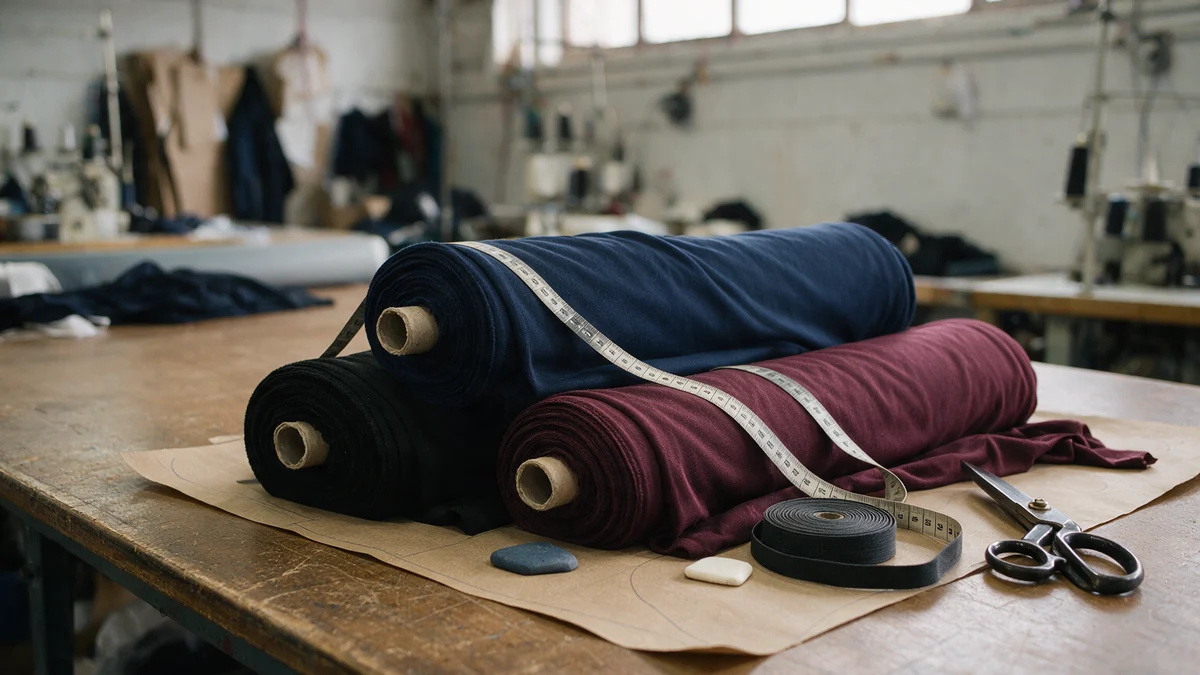
Interlock, the cloth Gemilang Apparel says it uses for its school track bottoms, is a double knit: the Pratt Institute’s textile library describes it as made “with two sets of needles”, locking the purl sides together, so it is “thicker and less stretchy” than jersey, “more stable”, and alike on both sides. Interlock is therefore what a school buys when it wants a cloth that holds its shape over a year of wear and does not curl at a cut edge. No public standard sets a weight for school track bottoms, so a GSM figure is useful only for comparing quotes like for like — which fibre and knit suit Malaysian heat is settled in our guide to the best fabric for school track bottoms in Malaysia.
Straight leg or tapered (kaki cekak): which cut works at school?
For a whole school, a straight leg is the safer default on school track bottoms, because one cut has to fit the widest range of body shapes; tapered suits older pupils who dislike a loose hem. What a school is really choosing is how close the cloth sits to the leg, and in Malaysian humidity that gap is worth something.
The Malaysian Meteorological Department calls the country’s climate one of “uniform temperature, high humidity and copious rainfall”, so sweat has to evaporate into air that is already damp. In their 2022 review in Sports Medicine – Open, Di Domenico, Hoffmann and Collins write that “[t]hermal comfort is significantly improved in loose-fitting compared to tight fitting synthetic sports clothing”, since tight clothes trap less air against the skin. Those authors also note that only one study has reported fit and microclimate humidity together, so treat it as a direction, not a rule.
A tapered leg narrows exactly that air gap, set against a hem that stays out of the way in PE — which is why a school settles the cut on pupils, not on paper. That trade-off matters more in the hot-weather weeks the ministry had in mind in March 2026. Both cuts are on Gemilang Apparel’s own spec for school track bottoms.
Which details decide whether school track bottoms last the school year?
Three parts decide whether school track bottoms survive the year: the waistband, the seams and the pockets. Where a school runs the two sports-attire days a week the ministry’s 2024 dress arrangement allows, each pair is pulled on, sat in and washed over and over, so check those three on the sample.
That arrangement — reported by RTM Berita as “dua hari pakaian seragam sekolah, dua hari pakaian sukan dan satu hari pakaian kokurikulum” (two days of school uniform, two days of sports attire, one day of co-curricular wear) — is what loads the garment. The elastic waistband and the crotch seam take that load every time a pupil sits, runs or changes for PE; Gemilang Apparel’s own spec lists a reinforced elastic waistband, reinforced seams for active wear and deep zip pockets. Ask for flat woven elastic in a casing rather than elastic stitched onto the cloth, and for a drawstring, which lets a child adjust the fit. Reinforcement belongs where the stress concentrates: crotch, inside leg seam, pocket corners.
- Stretch the waistband fully and let go, to see whether it returns.
- Turn the sample inside out and check the seam allowance and whether the seams are overlocked.
- Wash it once, the way parents actually will, then look again.
How hard that washing gets depends on how many school track bottoms a student needs: the fewer pairs in rotation, the more washes each one takes.
How do the school’s name and colours go on a pair of track bottoms?
A school’s colours and its name go onto a pair of track bottoms in two different ways. Colour on the garment usually comes from side piping (jalur tepi) in the school or house colours, sewn into the side seam. The name or crest is a separate printed or embroidered mark, usually on one thigh or above the hem.
Piping and the printed mark are two separate jobs, so price them as two lines in the same brief. Piping is a trim matched to your colour plus a sewing operation on every pair, and a single stripe and a double stripe are not the same job. A mark is costed on its own basis — a screen per colour for silkscreen, the printed area for sublimation, the stitch count for embroidery — so one piece of artwork is priced differently depending on the method named.
The cloth matters here too, because track bottoms are a stretch knit: the thread maker Madeira warns that without a stable backing under the embroidery, “[e]lastic fabrics in particular might otherwise move and puckering or mismatched stitches can occur”. Which method suits which design is compared in how to print your school logo on track bottoms. Send the colours as references rather than as words, and mark the position on a picture. Single or double piping in school colours is on Gemilang Apparel’s own spec, and it says it runs silkscreen, sublimation and computerised embroidery at its Kajang factory.
What sizes do school track bottoms come in, Standard 1 to Form 6?
School track bottoms are ordered as a size run covering the whole school rather than as a list of individual sizes, and the run is settled on a fitted sample. A letter on a label means nothing on its own, so ask which body measurements the maker’s chart is built on: waist, hip, inside leg and full length.
Try the sample on pupils at both ends of the run, collect sizes once per cohort rather than per class, and leave a buffer for pupils who grow or join later. On its own account, Gemilang Apparel’s standard sizing runs from primary Standard 1 to secondary Form 6.
What is the minimum order for a school track bottom run?
A custom school track bottom order normally carries a minimum quantity counted per design rather than per size, because every design needs its own pattern, screens or embroidery file before anything is cut. Ask what that per-design minimum is before deciding how many versions of the garment to order.
A per-design minimum is why a school ordering two piping colours is placing two runs, each with its own minimum — usually the argument for one school-wide track bottom, with house colours carried on the shirts. Gemilang Apparel says its minimum starts from 30 to 50 pieces per design, and that it couriers across Peninsular and East Malaysia or an order can be self-collected in Kajang. The rest of the sequence is in how to order custom school track bottoms in Malaysia.
Frequently asked questions
Who should approve the sample: the school or the PIBG?
Whoever will field the complaints, and it should be one named person: the teacher in charge of sports, or the PIBG member running the order. That person should also keep the approved sample until the delivery has been checked against it.
Do girls and Muslimah pupils need a different specification?
Often yes, and it is usually a looser leg and a longer rise rather than a different garment. Put it in the brief as its own line: how many pairs need the looser cut, and in which sizes. Gemilang Apparel says it returns a free digital mockup before anything is cut, so the second cut is settled then.
Apa beza seluar trek dengan seluar sekolah biasa? (How do track bottoms differ from school trousers?)
Seluar trek dibuat daripada kain rajutan yang meregang, berpinggang getah, dan dipakai pada hari pakaian sukan. Seluar sekolah biasa dijahit daripada kain tenunan yang tidak meregang, selalunya berzip, dan dipakai pada hari pakaian seragam. (Track bottoms are a stretchy knit with an elastic waist, for sports-attire days; school trousers a non-stretch woven, usually with a zip fly, for uniform days.) Gemilang Apparel says it makes both to order, and settles the trouser specification per order on the brief and the sample.
Sources
- RTM Berita, “Kelonggaran pakai baju sukan ke sekolah diteruskan bagi sesi 2024”, 19 January 2024 — berita.rtm.gov.my
- Malaysia MADANI, “Cuaca panas: Kebenaran khas… guna pakaian sukan”, 25 March 2026 — malaysiamadani.gov.my
- Di Domenico I, Hoffmann SM, Collins PK, “The Role of Sports Clothing in Thermoregulation, Comfort, and Performance During Exercise in the Heat”, Sports Medicine – Open, 2022 — pmc.ncbi.nlm.nih.gov
- Malaysian Meteorological Department, “General Climate of Malaysia” — met.gov.my
- Pratt Institute, Textile Resource Library, “Knits” — textileresearchlab.pratt.edu
- Madeira, “Stabilising the embroidery fabric for outstanding quality” — madeira.com
- Gemilang Apparel’s own account of its range and its ordering steps.