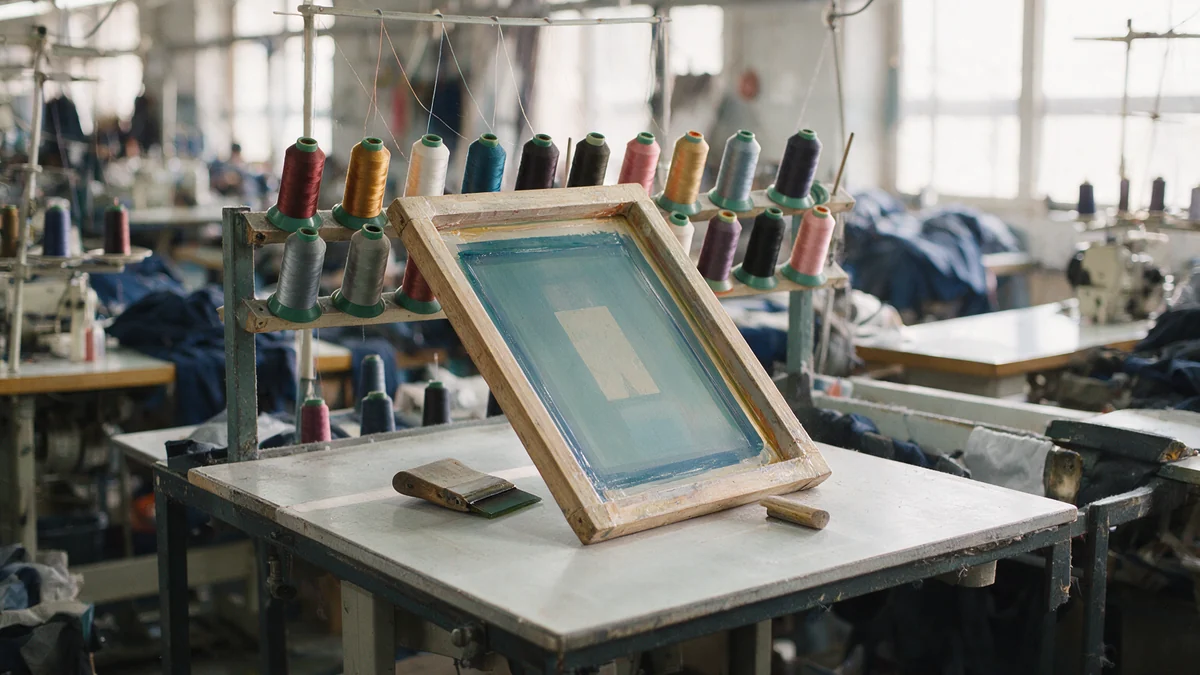
For school track bottoms, the method follows the fabric and the design. Track bottoms are usually polyester, so a large or full-colour design points to sublimation, a one or two-colour school name to silkscreen, and a crest the size of a badge to computerised embroidery. The cloth colour and the washing then decide between them.
A school has to answer that before any artwork is drawn, and the three usual answers behave very differently on the cloth track bottoms are made from.
Key takeaways
- Sublimation works directly on polyester; untreated cotton does not hold the same dye. US Patent 4,273,552 records that dye transferred to untreated cellulose "is not fixed and is removed almost entirely with the first washing".
- Silkscreen on dyed polyester can bleed, because the cloth's own dye gasses off near the temperature the ink is cured at (Screen Printing magazine).
- How the bottoms are washed changes the answer. The 2025 Clemson University study suggests sublimation on 100% polyester for commercially laundered kit — but under home laundering it found screen printing showed no noticeable visual change after five cycles.
- Embroidery on a stretch knit needs a stable backing or the cloth puckers and the stitches land off the design (thread maker Madeira).
Working out the mark for your school's next track bottom order? Gemilang Apparel says it takes the brief on WhatsApp at +60 13-340 8183.
On this page7
Silkscreen, sublimation or embroidery: which suits school track bottoms?
Three things decide it: what the design is, what cloth it goes on, and how the bottoms will be washed. Each method is also costed on a different basis — screens per colour, stitch count, or printed area — so a school should ask for all three against the same artwork and the same quantity, then compare.
| Method | Suits | What drives the cost | Watch for |
|---|---|---|---|
| Sublimation (cetakan sublimasi) | Full-colour or large designs, panels, gradients | The printed area | Polyester only; how it reads on your cloth colour |
| Silkscreen (sablon) | One or two-colour school names and logos across a large run | A screen per colour, plus set-up per design | Dye migration from dyed polyester into the ink |
| Computerised embroidery (sulaman komputer) | Small crests, badges, initials, prefect markings | Stitch count, so size and fine detail | Puckering and stitch shift on a stretchy leg |
School track bottoms are a harder case than a school T-shirt: the panel is narrow, stretchy and sewn near a seam or a pocket bag, so settle the position before the artwork. A mark sits best on a flat, single layer: high on the thigh or at the hip, clear of the pocket bag, the side seam and the elastic waistband. A fourth option needs no printing or embroidery at all: Gemilang Apparel says its track bottoms can be made with single or double side piping in school colours, carrying the school's colour down the leg in the cut of the garment.
Why does sublimation suit polyester track bottoms?
Sublimation suits polyester because the dye ends up inside the fibre rather than sitting on the surface as a layer. Under heat the disperse dye moves into the polyester, so the design becomes part of the cloth. Untreated cotton has no affinity for the same dye, which is why sublimation is used on polyester garments rather than on cotton ones.
US Patent 4,273,552, granted in 1981, sets out to pretreat cellulose so that it can be thermotransfer-printed — and in describing the problem it solves, it records that "Cellulose fibers on the other hand do not show any affinity to disperse dyes", and that the dye which does transfer "is not fixed and is removed almost entirely with the first washing".
That is what shapes a mixed school order. The interlock polyester cloth school track bottoms are usually cut from takes the dye, so sublimation is open to them — but cotton-rich garments bought on the same purchase order, such as house T-shirts or koko shirts, will not hold it, and need a different method for their mark. One order, two cloths, two methods.
Durability is the other half of the case: the 2025 Clemson University study by Erica B. Walker and Amanda W. Bridges, which measured how far printed brand colour shifts through laundering, suggests dye sublimation on 100% polyester for uniforms that go through commercial laundering.
Two things are worth asking before picking sublimation for a large design: how it will look on the cloth colour being ordered, and whether it is printed on the panels before the bottoms are sewn or onto a finished garment.
Will a silkscreen print bleed on coloured track bottoms?
A silkscreen print on coloured track bottoms can bleed, and the cause is temperature rather than the design. Where the cloth is dyed polyester, that dye can turn to gas during curing and move up into the printed ink, tinting it. Ask any maker how it controls the heat — and because the tint can appear late, ask to see the sample again about a week after it is printed.
Screen Printing magazine gives the temperature window: "Polyester dyes will sublimate at temperatures ranging from 360-420°F (182-215°C)", while garments are often cured at 320°F (160°C). It names the flash-curing unit, not the dryer, as the biggest cause. Ink alone does not close the gap:
"Low-bleed inks are designed to prevent dye migration. They are not designed to prevent dye sublimation. No ink can stop dye from sublimating at excessive temperatures."
— Screen Printing magazine, "Putting an End to Dye Migration"
Wash durability is a separate question from bleeding, and there the research is kinder to silkscreen than its reputation. The Clemson study advises against screen printing for commercially laundered uniforms, but under home laundering found it performed well on every tested textile, with no noticeable visual change after five cycles. That measures colour change over five washes, not a full school year — but for most families, home washing is the likelier case.
Does embroidery hold up on a stretchy track-bottom leg?
Embroidery holds up on track bottoms when the stitching is supported from behind. A track bottom leg is a stretch knit, so it moves under the needle unless a stable backing holds it still. Without that backing the cloth puckers and the stitches land off the design, which is a fault no amount of thread quality fixes.
Thread maker Madeira describes the mechanism in its own stabiliser guidance: a backing "is used to stabilise the garment during embroidery", and "Elastic fabrics in particular might otherwise move and puckering or mismatched stitches can occur". It defines a good backing as "stable, non-stretchy in any direction".
Embroidery on school track bottoms suits a crest, initials or a prefect marking rather than a design spanning the thigh. Gemilang Apparel says a physical sample is approved before mass production: that sample is where to check a crest for puckering, and a print for bleed, on the cloth the order will be cut from.
What should a school send its maker so the mark comes out right?
Send the artwork, the exact colours, the position and the quantity. Gemilang Apparel says it asks for the logo, colours, rough quantity and target date on WhatsApp, then returns a free digital mockup and a fabric recommendation, with a physical sample approved before production. The sample, not the mockup, is where to check the mark.
- The artwork as a file, not a photo — a photographed crest cannot be separated into screens or digitised cleanly.
- The colours as references, noting which are the school's and which are house colours.
- The position, marked on a picture, and whether it repeats on both legs.
- The quantity per design — Gemilang Apparel says its minimum order starts from 30 to 50 pieces per design.
- How many sets each student will own, since how often the bottoms are washed is what durability turns on.
Gemilang Apparel says it makes school track bottoms and trousers at its own factory in Kajang, Selangor, and runs silkscreen printing, sublimation and computerised embroidery there as well.
Frequently asked questions
Which method is cheapest for a school order?
There is no single answer, because each method is costed on a different thing. Silkscreen is costed per colour, since every colour needs its own screen and set-up. Embroidery is costed on stitch count, so size and fine detail drive it. Sublimation is costed on the printed area. Send one brief with the same artwork, the same quantity and all three methods named, or the quotes will not compare.
Can one school order use different methods on different garments?
Yes. Gemilang Apparel says it runs all three in its own factory in Kajang, and that it can make a school's sports day, house and co-curricular wear in one order. Say which mark belongs on which garment in the brief: a cotton-rich shirt and a polyester track bottom will not take the same one.
Apa nama kaedah-kaedah ini dalam Bahasa Melayu? (What are these methods called in Malay?)
Silkscreen printing biasanya dipanggil sablon atau cetakan sutera saring. Sublimation dipanggil cetakan sublimasi, iaitu pewarna meresap ke dalam kain polyester. Embroidery pula ialah sulaman; sulaman komputer bermaksud ia dijahit oleh mesin yang membaca fail reka bentuk. Minta mockup digital dan sampel sebenar sebelum pesanan besar dibuat.
Sources
- US Patent 4,273,552, "Process for the pretreatment of cellulose fibers to be printed according to the thermotransfer printing method", granted 16 June 1981 — patents.google.com
- Screen Printing magazine, "Putting an End to Dye Migration" (undated) — screenprintingmag.com
- Erica B. Walker and Amanda W. Bridges, Clemson University, "The Impact of Commercial Laundering on Brand Color Durability on Printed Textiles", TAGA 2025 Proceedings (abstract) — library.taga.org
- Madeira, "Stabilising the embroidery fabric for outstanding quality", accessed 17 October 2026 — madeira.com